
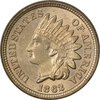
Indian Cents
Indian Head Cents 1859-1909
The Indian Head cent stands as one of America's most beloved and historically significant small cent designs, minted from 1859 through 1909. Created by Chief Engraver James Longacre, these remarkable coins feature Lady Liberty wearing a Native American headdress, representing a fascinating chapter in American numismatic heritage that collectors have treasured for generations. Today, the Indian Head cent remains arguably one of the most popular 19th-century coins, appealing to both seasoned numismatists and beginning collectors.
The series offers exceptional variety through its fifty-year production run, encompassing three distinct types, composition changes, design modifications, and numerous sought-after varieties. From common dates accessible to new collectors to legendary key dates like the 1877 and 1909-S, Indian Head cents provide collecting opportunities at every budget level while preserving an important era of American history.
Origin & History
The Indian Head cent emerged in 1859 as the replacement for the problematic Flying Eagle cent, which suffered from striking difficulties due to opposing high points on both sides of the coin. Chief Engraver James Longacre was instructed to develop alternative designs, ultimately creating the Indian Head motif that would serve American commerce for half a century. In 1858, the Mint tested new designs by striking between 60 and 100 sets of twelve pattern coins, including the Indian Head design paired with various reverse wreaths. The selected design proved both practical for production and symbolically meaningful during a period of westward expansion and growing national identity.
The timing of the Indian Head cent's introduction proved historically significant. The first years of production fell just prior to the outbreak of the Civil War, making these pieces tangible connections to pivotal moments in American history. The coin witnessed the entire Civil War era, Reconstruction, the Industrial Revolution, and America's emergence as a world power. Production remained limited to the Philadelphia Mint until 1906 legislation permitted base metal coins to be struck at branch mints, leading to the rare San Francisco issues of 1908 and 1909.
Design Elements
The obverse design features Lady Liberty wearing an Indian chief's headdress rather than an actual Native American, as one might assume. The portrait faces left, with "UNITED STATES OF AMERICA" encircling the top and the date positioned at the bottom. Longacre added his initial "L" to the ribbon in Liberty's hair near the last feather in 1864, though some rarer 1863-dated pennies also bear this mark. The design underwent subtle modifications throughout the series, including the transition from pointed to rounded bust cutoffs in 1860.
The reverse design evolved through three distinct phases:
- 1859: Plain laurel wreath tied at bottom with ribbon encircling "ONE CENT"
- 1860-1909: Oak wreath with narrow shield added to the top, creating a more patriotic appearance during the Civil War era
- Design refinements: Various adjustments to wreath details and letter positioning, including the 1886 "AMERICA" positioning change that created two distinct varieties
The artistic elements demonstrate Longacre's skilled craftsmanship, with intricate feather details, flowing ribbon work, and balanced composition that remained striking throughout the series' production.
Varieties & Key Dates
Indian Head cents offer collectors an abundance of varieties and key dates that have captivated numismatists for generations. The legendary 1877 Indian Head cent serves as the series' most famous key date, with low grade examples worth around $500 and mint state pieces commanding $5,000 or significantly more. The 1909-S cent, with a mintage of only 309,000 pieces, represents the lowest mintage of the series and commands substantial premiums.
The 1873 Doubled Liberty stands as the "King of Indians" due to impressively dramatic doubling on all letters of LIBERTY, the eyes, nose, lips, and feather veins. This scarce variety starts at more than $150 in Good-4 condition and increases significantly in higher grades. The remarkable 1888/7 overdate, where the last "8" was punched over a "7," represents one of the most valuable Indian Head cent varieties known, with prices reaching five figures at auction. Every date issued between 1866 and 1878 presents challenges for collectors in any grade, making this