
Barber Dimes
Barber Dimes
The Barber dime stands as one of America's most elegant and historically significant silver coins, captivating collectors with its classical beauty and numismatic importance. Minted from 1892 to 1916, these dimes were part of Charles E. Barber's distinguished trio of silver coinage that included Barber quarters and Barber half dollars bearing the same iconic design.
Featuring Liberty's laureate head on the obverse and a precisely crafted wreath on the reverse, Barber dimes represent a pivotal era in American coinage. From common dates accessible to beginning collectors to legendary rarities like the 1894-S, these dimes offer both affordable collecting opportunities and the thrill of pursuing some of numismatics' greatest treasures.
Origin & History
The Barber dime emerged during a period of significant artistic transition in American coinage. By the late 1880s, the long-running Seated Liberty design had been in circulation for over 50 years and faced increasing criticism for its lack of creativity and aesthetic appeal.
In 1890, after an unsuccessful public design competition that attracted no suitable candidates, Mint Director Edward O. Leech instructed Chief Engraver Charles E. Barber to create new designs for the dime, quarter, and half dollar.
Barber, who had served as Chief Engraver since 1879, developed a classically inspired design that reflected the conservative artistic sensibilities of the era. The first Barber dimes were struck in January 1892, replacing the Seated Liberty design that had been used since 1837. Production continued steadily at the Philadelphia, New Orleans, and San Francisco Mints, with Denver joining in 1906 after that facility opened.
The Barber dime circulated during a transformative period in American history, witnessing the Spanish-American War, President McKinley's assassination, the Wright brothers' first flight, and the beginning of World War I.
After 25 years—the minimum required by law before a design change—the Barber dime was replaced by Adolph A. Weinman's iconic Mercury (or Winged Liberty) dime in 1916, concluding one of the most respected and collected series in American numismatics.
Design Elements
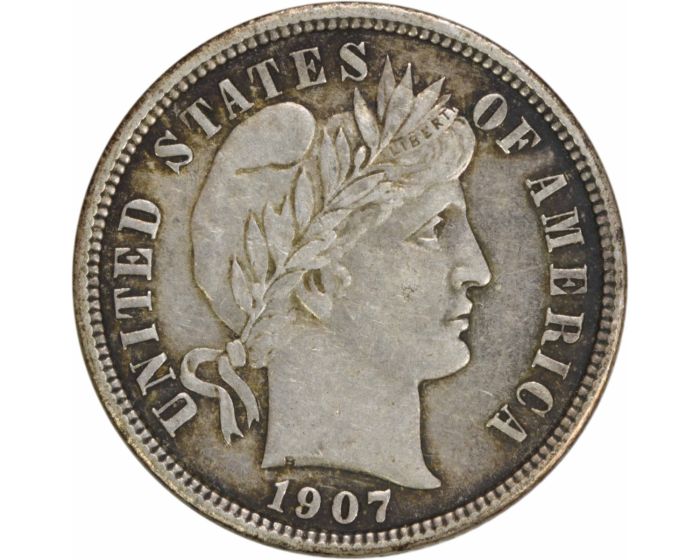
The obverse of the Barber dime features a right-facing profile of Liberty wearing a Phrygian cap adorned with a laurel wreath, symbolizing freedom and victory. Her hair is neatly bound, and she wears a small headband inscribed with the word "LIBERTY."
The design is encircled by the inscription "UNITED STATES OF AMERICA" and the date appears at the bottom. Unlike the quarter and half dollar in the series, which place the motto "IN GOD WE TRUST" on the reverse, the dime's smaller diameter required placing this inscription on the obverse, positioned above Liberty's head.
The design exhibits the neoclassical influence popular during the late 19th century, with precise details in Liberty's features and headwear.
The reverse design remained consistent throughout the series:
- 1892-1916: A simple yet elegant wreath composed of corn, wheat, maple leaves, and oak leaves encircles the denomination "ONE DIME" in the center. The wreath's botanical elements represent America's agricultural heritage and natural resources. Unlike the Barber quarter and half dollar, which feature an eagle design on their reverse, the dime's smaller size necessitated a simpler composition.
Authentic Barber dimes measure 17.9mm in diameter and weigh 2.5 grams, composed of 90% silver and 10% copper. Mint marks appear on the reverse below the wreath, with "O" for New Orleans, "S" for San Francisco, and "D" for Denver.
Philadelphia-minted coins carry no mint mark, following the convention of the time. The coin's edge features 118 reeds, providing a protective border and deterring clipping—the illegal practice of shaving precious metal from the coin's perimeter.
Varieties & Key Dates
The Barber dime series contains several scarce issues and varieties that have achieved legendary status among collectors. The undisputed king of the series—and perhaps of all American coinage—is the 1894-S, with only 24 specimens struck at the San Francisco Mint.
The circumstances surrounding this extremely rare issue remain mysterious, though various theories suggest they were struck to balance the mint's books or as special presentation pieces. With only nine examples confirmed to exist today, the 1894-S has achieved mythic status, with specimens selling for millions when they occasionally appear at auction.
Beyond this supreme rarity, several key dates challenge collectors building a complete set. The 1895-O, with a mintage of just 440,000 from the New Orleans facility, stands as one of the most difficult dates to locate in higher grades, as most entered circulation and saw extensive wear.
Similarly, the 1901-S represents a significant condition rarity, with uncirculated examples commanding substantial premiums due to their scarcity.
The 1896-O and 1904-S also present challenges, particularly in mint state, while the final-year 1916-S has gained popularity as a transitional date before the Mercury dime's introduction.
For variety specialists, the 1905-O Micro O presents an intriguing pursuit—created when a mint mark punch intended for quarters was erroneously used on dime dies, resulting in a noticeably smaller "O" than standard.
Other collectible varieties include the 1893/2 overdate, showing evidence of a "2" beneath the "3" in the date, and various repunched mint marks and misplaced dates that specialists eagerly seek. Philadelphia-minted Barber dimes are generally more available than their branch mint counterparts, though certain years like 1894, 1895, and 1913 have lower mintages that make them scarcer in the marketplace.
For budget-conscious collectors, the later dates from 1911-1915 are relatively affordable even in better circulated grades, providing accessible entry points to this historic series. Browse L&C Coins' inventory of authenticated Barber dimes to find specimens that match your collecting goals and budget.
Collecting Insights
Building a quality Barber dime collection requires understanding the nuances of strike, surface preservation, and originality that distinguish exceptional specimens.
When evaluating potential purchases, first examine strike quality, paying particular attention to Liberty's headband (where "LIBERTY" often appears weak), the wreath details, and the high points of Liberty's cheek and hair.
Well-struck examples with full details command significant premiums, especially for dates known for typically soft strikes like many New Orleans issues.
Original surfaces remain highly prized among knowledgeable collectors. Authentic toning—ranging from light silver-gray to deeper cabinet tones with hints of blue, gold, or russet—indicates a coin that has never been harshly cleaned.
Unfortunately, many Barber dimes were cleaned during the mid-20th century when the practice was common, making naturally toned examples with original luster particularly desirable today. For circulated coins, the grade significantly impacts value, with even small improvements in condition often doubling or tripling a coin's worth.
The transition from Very Fine (VF) to Extra Fine (EF) represents a particularly important threshold, as dimes in EF and better grades retain enough detail to fully appreciate Barber's intricate design.
For those unable to pursue the legendary 1894-S, consider a date-and-mint set excluding this supreme rarity, or focus on a specific mint like Denver or New Orleans.
Type collectors often select a single premium example to represent the series, while others assemble short sets of the final years (1911-1916) when more specimens survived in better grades.
L&C Coins offers authenticated Barber dimes graded according to ANA standards, with options to match every collector's budget and objectives. Explore our selection today and add these historic silver coins to your collection with confidence, knowing each purchase includes our 15-day return privilege and free shipping.
Frequently Asked Questions
What makes the 1894-S Barber dime so valuable and rare?
The 1894-S Barber dime is one of the greatest rarities in American numismatics because only 24 were originally minted, with just nine confirmed examples known today. These coins were struck under mysterious circumstances at the San Francisco Mint, possibly as special presentation pieces or to balance the mint's books. Their extreme scarcity combined with the fascinating story behind their creation has propelled their value into the millions, with one specimen selling for $1.99 million in 2016.
How can I tell if a Barber dime is properly graded?
Properly graded Barber dimes show consistent wear patterns relative to their assigned grade. In circulated examples, check Liberty's cheek, hair details, and the word "LIBERTY" on the headband—these areas wear first. On the reverse, examine the definition in the wreath leaves. For uncirculated coins, look for original mint luster and minimal bag marks. Professional grading services like PCGS or NGC provide consistent standards, but collectors can also learn grading by studying reference materials and examining coins at L&C Coins, where all specimens are graded according to ANA standards.
Are Barber dimes a good starting point for collecting silver coins?
Barber dimes offer excellent entry points for silver coin collectors. Common dates in circulated condition remain affordable, allowing beginners to experience owning genuine 90% silver coins with historical significance. The series provides room to grow as collectors can pursue better dates, higher grades, or varieties as their budget and knowledge expand. Additionally, with 74 date and mint mark combinations (excluding the 1894-S), collectors can build meaningful collections without requiring every issue, making the series adaptable to various collecting strategies and budgets.
How do I identify the 1905-O Micro O variety?
The 1905-O Micro O Barber dime is distinguished by its unusually small "O" mint mark, created when a quarter dollar mint mark punch was mistakenly used for dime dies. When comparing to regular 1905-O dimes, the Micro O appears noticeably smaller and more delicate, positioned below the wreath on the reverse. Under magnification, the difference becomes even more apparent, with the Micro O having thinner lines and less interior space. This variety is scarce but actively sought by specialists, with authenticated examples commanding significant premiums over the standard 1905-O.
What's the difference in appearance between Barber dimes and Mercury dimes?
Barber dimes (1892-1916) feature Liberty wearing a laurel wreath and Phrygian cap with "LIBERTY" on the headband, facing right, with a simple wreath surrounding "ONE DIME" on the reverse. Mercury dimes (1916-1945) show Liberty wearing a winged Phrygian cap (often mistaken for the Roman god Mercury), facing left, with a fasces (bundle of rods) wrapped in an olive branch on the reverse. The artistic style differs significantly—Barber's design is more formal and neoclassical, while Weinman's Mercury design exhibits the flowing Art Nouveau style popular in the early 20th century.
What years were Barber dimes minted at each mint location?
Barber dimes were minted at four different facilities: Philadelphia (no mint mark) produced coins every year from 1892-1916; San Francisco (S) struck dimes every year except 1894 (excluding the rare 1894-S); New Orleans (O) operated from 1892 until the mint's closure in 1909, skipping only 1895 and 1902; Denver (D) began producing Barber dimes when the facility opened in 1906 and continued through 1916. Each mint location has its own striking characteristics, with Philadelphia generally producing the sharpest strikes and New Orleans often creating softer-struck coins.
Discover Quality, History-Rich Coins at L&C Coins
L&C Coins is a family-owned and operated business founded by coin enthusiast Lee Crane. Since 1974, we've offered our loyal customers a diverse selection of authentic and rare coins at a variety of price points to suit collectors of all levels.
In addition to a history-rich collection of both certified and uncertified coins, you'll enjoy free shipping with every standard order and free express shipping for orders of $25 or more. Should you have any questions, don't hesitate to contact our team of experts — we're here to help.