
Mercury Dimes
Mercury Dimes (1916-1945)
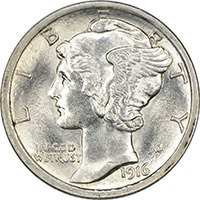
The Mercury Dime stands as one of America's most artistically significant and beloved coin series. Minted from 1916 to 1945, these iconic silver ten-cent pieces showcase Adolph A. Weinman's masterful design of Liberty wearing a winged Phrygian cap??a feature that led the public to mistake her for the Roman god Mercury, giving the coin its enduring nickname.
With their 90% silver composition, intricate details, and fascinating varieties, Mercury dimes offer collectors an accessible yet challenging pursuit. From the legendary key-date 1916-D to the elusive Full Bands specimens, these coins connect us to a pivotal era spanning both World Wars and the Great Depression, making them treasured collectibles for both novice and advanced numismatists alike.
Origin & History
The Mercury Dime emerged during a renaissance in American coin design championed by President Theodore Roosevelt, who sought coins that better reflected artistic excellence. By 1915, the Barber dime had been in circulation for nearly 25 years, making it eligible for redesign without congressional approval. Treasury Secretary William G. McAdoo seized this opportunity, holding a competition that ultimately selected German-American sculptor Adolph A. Weinman's design over entries from Chief Engraver Charles Barber and others.
Weinman's design featured a young Liberty wearing a winged cap symbolizing "freedom of thought," though the public quickly misinterpreted this as the Roman messenger god Mercury. The model for Liberty is widely believed to have been Elsie Stevens, wife of poet Wallace Stevens and a friend of the sculptor though this was never publicly confirmed by Weinman himself. The reverse design featured a fasces (a bundle of rods with an axe) representing strength in unity, surrounded by an olive branch symbolizing peace.
Production began in late 1916 at all three operational mints: Philadelphia, Denver, and San Francisco. The series would continue through 1945, with no coins produced during 1932-1933 amidst the Great Depression. The Mercury dime was eventually replaced in 1946 by the Roosevelt dime, created to honor the recently deceased president. During its three decades of production, the series saw the introduction of several notable varieties and key dates that continue to challenge collectors today, making these coins both historically significant and numismatically fascinating.
Design Elements
The Mercury Dime's obverse presents a left-facing profile of Liberty wearing a Phrygian cap adorned with wings. The design exhibits remarkable detail in Liberty's facial features and the cap's wings, despite the coin's small size. "LIBERTY" appears along the upper rim, while "IN GOD WE TRUST" is positioned to the left of Liberty's neck. The date is located at the bottom rim, and Weinman's monogram "AW" is subtly placed near the bottom of Liberty's neck. The portrait's classical beauty combined with the symbolic wings created one of the most visually appealing designs in American coinage.
The reverse design features several symbolic elements arranged in a harmonious composition:
- Fasces: The central element is a Roman fasces, a bundle of rods bound together with an axe head protruding, symbolizing strength through unity. Weinman explained in a 1916 letter that the battle ax represented preparedness to defend the Union.
- Olive Branch: Encircling the fasces is an olive branch, symbolizing America's desire for peace even while remaining strong. The detailed leaves and olives showcase Weinman's attention to detail.
- Central Bands: Three horizontal bands secure the fasces bundle, with the middle band being particularly significant for collectors as its complete separation (known as "Full Bands") indicates an exceptional strike.
- Inscriptions: "UNITED STATES OF AMERICA" arcs along the top of the coin, while "ONE DIME" appears at the bottom. The mint mark, when present, is located to the right of the fasces near the bottom.
The design remained consistent throughout the series' production, though minor variations in strike quality created the highly collectible "Full Bands" specimens. The coin measures 17.9mm in diameter, weighs 2.5 grams, and contains 0.0723 troy ounces of silver, with a composition of 90% silver and 10% copper. This elegant combination of artistic beauty and meaningful symbolism has made the Mercury Dime one of America's most beloved coin designs.
Varieties & Key Dates
The Mercury Dime series features several significant key dates and varieties that are indispensable for collectors to understand. Towering above all others is the legendary 1916-D, the undisputed king of the series. With a mintage of only 264,000 pieces, it remains one of the rarest regular-issue business strikes of the 20th century. Even in well-worn grades, authentic examples command $650-$800, while premium uncirculated specimens have sold for over $200,000. This coin's rarity results from the Denver Mint's decision to prioritize quarter production late in 1916, cutting short the first-year dime production.
The economic downturn following World War I led to limited mintages in 1921, creating two important semi-key dates. The 1921 Philadelphia issue had a mintage of 1,230,000 pieces, while the 1921-D saw even fewer at 1,080,000. These coins typically sell for $55-$70 in lower grades but can command several thousand dollars in mint state. Another notable semi-key is the 1926-S, which suffers from chronically weak strikes, making well-struck examples particularly valuable to specialists.
Among varieties, the 1942/1 overdate (both Philadelphia and Denver versions) represents an intriguing error. These coins were created when dies originally prepared with the 1941 date were repunched with 1942, creating a visible overdate. Though relatively common in circulated grades, these overdates are genuinely rare in uncirculated condition, with premium examples selling for five figures.
Other collectible varieties include the 1945-S "Micro S" with an unusually small mintmark, and various instances of repunched mintmarks throughout the series. For specialists seeking additional challenges, several dates are known for weak strikes, including the 1919-D, 1924-D, and 1925-D, making well-struck examples with Full Bands exceedingly rare.
Mercury Dimes struck from 1934-1945 (the "late dates") are generally more available in all grades, making them excellent starting points for new collectors. However, even common dates become scarce in gem uncirculated condition with Full Bands, providing collecting challenges at every level. For collectors seeking a truly rare find, high-grade examples of early San Francisco and Denver issues represent some of the most elusive coins in 20th-century American numismatics.
Collecting Insights
Building a quality Mercury Dime collection requires understanding the series' unique characteristics and grading challenges. Strike quality varies dramatically throughout the series, with many dates exhibiting chronic weakness on the central horizontal bands of the fasces. The "Full Bands" designation is granted to Mercury Dimes in which the central set of bands shows a complete split in the middle, indicating an exceptional strike. This detail is particularly scarce on early branch mint issues, and collectors are often willing to pay substantial premiums for coins displaying this characteristic.
When evaluating Mercury Dimes, pay close attention to the high points of the design, which show wear first: Liberty's cheek, hair details, and wing feathers on the obverse, and the horizontal bands on the reverse. In circulated grades, even slight wear on Liberty's cheek and the central bands can affect the grade, while mint state coins should retain full luster with no traces of wear, though they may exhibit contact marks from mint handling.
For collectors with limited budgets, consider pursuing a "short set" of Mercury Dimes from 1934-1945, which excludes the most expensive key dates. Alternatively, a year collection (one coin from each year of issue) provides a representative sampling without requiring multiple examples from each mint. More advanced collectors often specialize in specific aspects, such as seeking Full Bands examples exclusively or focusing on early mint marked issues. Many collectors also pursue complete type coin collections that include Mercury dimes alongside other classic American designs like Morgan dollars and Lincoln cents.
Authentication becomes particularly important when purchasing key dates like the 1916-D, 1921, and 1921-D, as well as the 1942 overdates. Working with reputable dealers like L&C Coins provides proper authentication and grading according to American Numismatic Association standards, ensuring that you receive genuine coins properly attributed and fairly priced. Browse our extensive inventory of Mercury Dimes today, with free shipping on all standard orders and our 15-day return privilege providing peace of mind with every purchase.
Frequently Asked Questions
Why is it called a "Mercury" dime when it doesn't actually depict Mercury?
Though officially named the Winged Liberty Head dime, the coin gained its popular nickname because the public mistook Liberty's winged cap for the petasos (winged helmet) worn by the Roman god Mercury. Designer Adolph Weinman actually intended the wings to symbolize "liberty of thought," but the Mercury name stuck and remains the coin's common designation today, even among numismatists.
What makes the 1916-D Mercury dime so valuable?
The 1916-D Mercury dime's exceptional value stems from multiple factors: its extremely low mintage of just 264,000 pieces (the lowest in the series by far), its status as a first-year issue, and its production at the Denver Mint. Production was halted after the U.S. Treasury department entered an urgent order late in 1916 for quarter dollars, limiting the dime's mintage. Additionally, as a first-year issue, fewer were saved by collectors, making well-preserved examples particularly scarce today.
What does "Full Bands" mean, and why is it important?
"Full Bands" (often abbreviated as FB) refers to complete separation of the central horizontal bands on the fasces on the coin's reverse. This detail indicates an exceptional strike from fresh dies under ideal pressure. Since the central bands represent one of the highest points of the coin's design, this area tends to show weakness first as dies wear. Mercury dimes with Full Bands typically command significant premiums, sometimes 10-100 times the value of coins without this characteristic, depending on date and overall grade.
How much silver is in a Mercury dime?
Mercury dimes were struck in an alloy of 90% silver and 10% copper. Each coin contains approximately 0.0723 troy ounces of pure silver. At today's silver prices, this gives each coin an intrinsic metal value of about $2, though numismatic value for most dates exceeds this significantly. Even common dates in average circulated condition typically sell for slightly above their silver value due to collector demand.
Should I clean my Mercury dimes?
Absolutely not. Cleaning coins, particularly by abrasive methods, permanently damages their surfaces and significantly reduces their collector value. Professional numismatists universally advise against cleaning coins, as even well-intentioned cleaning removes the original surface and patina that collectors prize. If you have dirty coins, consider having them professionally conserved by experts who can safely remove harmful contaminants without damaging the coin's surfaces.
What are the most affordable Mercury dimes for beginning collectors?
Beginning collectors should focus on the "late dates" from 1934-1945, which are generally more affordable and available in better grades. These Mercury dimes are classified as "late dates" by collectors and are nearly all common and easily acquired in circulated grades. Common dates like 1940, 1942, 1943, 1944, and 1945 from the Philadelphia Mint are excellent starting points, available in attractive circulated condition for modest premiums over silver value, and even in lower uncirculated grades for reasonable prices.
How can I tell if my Mercury dime is properly struck?
Examine the central horizontal bands on the fasces (the bundle of rods) on the reverse. On well-struck coins, these bands should show complete separation with a visible recessed area between them. The top and bottom bands should also demonstrate clear definition. Additionally, check Liberty's hair details on the obverse, particularly the lines above her forehead, which often show weakness on poorly struck examples. The coin should also show sharp rim definition and clear details in the olive branch on the reverse.
Discover Quality, History-Rich Coins at L&C Coins
L&C Coins is a family-owned and operated business founded by coin enthusiast Lee Crane. Since 1974, we've offered our loyal customers a diverse selection of authentic and rare coins at a variety of price points to suit collectors of all levels.
In addition to a history-rich collection of both certified and uncertified coins, you'll enjoy free shipping with every standard order and free express shipping for orders of $25 or more. Should you have any questions, don't hesitate to contact our team of experts — we're here to help.