Roosevelt Dimes
Roosevelt Dimes (1946-Present)
The Roosevelt dime represents a marriage of American history and numismatic artistry. First minted in 1946 to honor President Franklin D. Roosevelt following his death in 1945, these iconic ten-cent pieces have become one of America's longest-running coin designs. Initially struck in 90% silver until 1964 before transitioning to copper-nickel, Roosevelt dimes offer collectors diverse collecting opportunities spanning over 75 years of production.
From key dates like the 1949-S and elusive varieties like the 1964 Special Mint Set dime to modern treasures such as the 1996-W, these coins capture the legacy of Roosevelt's leadership while providing accessible yet rewarding collecting challenges for both novice and advanced numismatists seeking to build comprehensive dime collections.
Origin & History
The Roosevelt dime arose from the nation's desire to honor President Franklin D. Roosevelt after his death in April 1945. As the leader who guided America through both the Great Depression and most of World War II, Roosevelt had a personal connection to the dime denomination through his founding of the National Foundation for Infantile Paralysis (later renamed the March of Dimes), which raised funds for polio research and treatment—a disease Roosevelt himself battled.
Less than a month after Roosevelt's death, Representative James Hobson Morrison introduced legislation to replace the Mercury dime with a design honoring the late president. The bill quickly gained support and was signed into law by President Harry S. Truman. Chief Engraver John R. Sinnock was tasked with creating the design, though controversy would later emerge regarding his inspiration sources, with some claiming he drew from sculptor Selma Burke's bronze relief portrait or photographer Marcel Sternberger's 1936 photograph of Roosevelt.
Production began in 1946 with the Philadelphia, Denver, and San Francisco mints producing over 350 million dimes that first year. From 1946 through 1964, Roosevelt dimes were struck in 90% silver and 10% copper. The Coinage Act of 1965, responding to rising silver prices, changed the composition to copper-nickel clad (75% copper, 25% nickel over a pure copper core), which continues in circulation coins today. Since 1992, the U.S. Mint has also produced special silver proof versions for collectors, initially in 90% silver and, since 2019, in 99.9% fine silver.
Design Elements
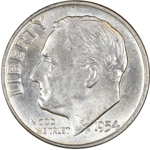
The obverse of the Roosevelt dime features a left-facing profile portrait of Franklin D. Roosevelt, conveying dignity and strength through its clean, classical design. "LIBERTY" appears along the upper rim in front of Roosevelt's face, while "IN GOD WE TRUST" is positioned in smaller letters below the chin. The date is located at the lower right, with designer John R. Sinnock's initials "JS" subtly placed just below the neckline truncation. These initials sparked controversy when the coin was first released, with some erroneously suggesting they represented Joseph Stalin during the early Cold War tensions.
The reverse design elements have remained consistent throughout the series:
- 1946-Present: The reverse features a torch with flowing flame at center, symbolizing liberty, flanked by an olive branch (representing peace) on the left and an oak branch (representing strength and independence) on the right—creating a design unique among circulating U.S. coinage. The legend "UNITED STATES OF AMERICA" arcs around the top rim, while "ONE DIME" appears at the bottom, separated by centered dots.
- Mint Marks: On silver issues (1946-1964), the mint mark appears on the reverse, positioned to the right of the torch's base. After 1964, mint marks were moved to the obverse, appearing below the date.
- Composition Changes: While not visibly different, the composition shifted from 90% silver (1946-1964) to copper-nickel clad (1965-present), slightly altering the coin's color from silver-white to silver-gray.
Identifying authentic Roosevelt dimes requires attention to design details, proper font characteristics, and appropriate mint marks. The dime measures 17.91mm in diameter and weighs 2.27 grams (for silver issues) or 2.27 grams (for clad issues), with a reeded edge that contains 118 reeds.
Varieties & Key Dates
While lacking a major rarity like the 1916-D Mercury dime, the Roosevelt series offers numerous collectible key dates and varieties that appeal to specialists. Among silver Roosevelt dimes (1946-1964), collectors particularly prize the 1949-S, with its relatively low mintage of just 13.5 million pieces. When found in Mint State with "Full Bands" (showing complete horizontal bands on the torch), these can command significant premiums, with exceptional specimens reaching thousands of dollars at auction.
The 1950-S and 1950-S/D (an overdate variety) are similarly sought after, as is the 1951-S in higher grades. The 1955 Philadelphia issue represents a conditional rarity in grades above MS-66, especially with Full Bands. Among traditional key dates, the 1949 (all mints) and 1950-S stand out for experienced collectors.
Doubled die varieties add excitement to the series, with the 1946 Philadelphia Doubled Die Obverse showing doubling on Roosevelt's features and date. The 1947-S Doubled Die Reverse displays doubling on the torch and branches. The 1960 and 1963 proof doubled dies are especially prized by variety collectors who also pursue Lincoln cent varieties and other error coins.
In the clad era (1965-present), several issues stand out. The 1982 "No P" variety resulted when a die was mistakenly placed into service without the Philadelphia mint mark, creating a modern rarity distributed primarily in Ohio and parts of Pennsylvania. The 1996-W dime, struck at the West Point Mint to commemorate the 50th anniversary of the Roosevelt dime, was only available in mint sets and represents the first "W" mint mark on a dime.
Modern condition rarities include the 1969-P, 1982-P, 1983-P, and 1999-D with Full Torch/Full Bands designation, some commanding thousands in top grades due to their exceptional strike quality in an era of mass production. Collectors often pursue these alongside other challenging series like Jefferson nickels for comprehensive 20th-century type sets.
Collecting Insights
Building a quality Roosevelt dime collection requires attention to strike quality, preservation, and authenticity. Unlike many classic U.S. coin series, complete date sets of Roosevelt dimes remain accessible to collectors at various budget levels, making them an excellent starting point for beginners or a rewarding specialty for advanced numismatists pursuing type coin collections.
Strike quality deserves particular attention when evaluating Roosevelt dimes. The "Full Bands" or "Full Torch" designation (terminology varies by grading service) indicates specimens with complete, sharp horizontal bands on the torch handle. This characteristic, especially scarce on certain dates, significantly enhances value—sometimes increasing worth tenfold or more versus standard strikes. Examine the bands carefully under magnification when considering premium examples.
For silver Roosevelt dimes (1946-1964), original toning can add substantial appeal. Naturally toned specimens with rainbow, blue, or golden hues are highly prized by collectors, while artificial toning and cleaned coins typically sell at discounts. Clad issues generally display less toning variety but are evaluated primarily on strike quality and surface preservation.
When collecting proof issues (1950-present), look for specimens with deep, mirror-like fields and frosted devices, known as "cameo" or "deep cameo" (DCAM) contrast. Early proof Roosevelt dimes (1950-1955) with DCAM contrast are especially rare and command significant premiums, while more recent issues typically show stronger contrast due to improved production techniques.
Many collectors combine Roosevelt dimes with related series like Barber dimes or build comprehensive silver collections including Washington quarters and Franklin half dollars from the same era. Explore L&C Coins' selection of authenticated Roosevelt dimes to find examples matching your collecting goals, all backed by our free shipping policy and 15-day return privilege.
Frequently Asked Questions
Which Roosevelt dimes contain silver?
Roosevelt dimes minted from 1946 through 1964 contain 90% silver and 10% copper. After 1964, regular circulation dimes switched to copper-nickel clad composition with no silver content. However, special silver proof dimes have been produced for collectors since 1992, initially in 90% silver and, since 2019, in 99.9% fine silver as part of various collector sets.
What makes a Roosevelt dime valuable beyond its silver content?
Beyond silver content, value is determined by rarity, condition, strike quality, and variety status. Low-mintage dates like the 1949-S command premiums, as do error varieties like the 1982 "No P" dime. Coins with "Full Bands" or "Full Torch" designation showing complete horizontal bands on the reverse torch can bring significant premiums. For modern issues, the commemorative 1996-W dime is particularly valuable as it was only included in mint sets and represents the first dime with the "W" mint mark.
How can I identify Roosevelt dimes with "Full Bands" or "Full Torch"?
Examine the horizontal bands on the upper and lower portions of the torch handle using at least 5x magnification. On Full Bands/Full Torch examples, these bands appear completely and sharply defined from left to right, with clear separation between them. This strike characteristic is relatively common on proof issues but scarce on many circulation strikes, especially from certain years and mints. Professional grading services like PCGS and NGC formally certify this designation, which can dramatically increase a coin's value.
Are there any valuable modern Roosevelt dimes I might find in circulation?
Yes, the 1982 "No P" variety (missing Philadelphia mint mark) is the most valuable circulation find, worth hundreds in uncirculated condition. Additionally, die varieties like the 1964-D Doubled Die Reverse show doubling on design elements and command premiums. Modern dimes (1982-P, 1983-P, 1999-D) with exceptional strike quality can also be valuable in mint state. While finding significant treasures in circulation has become increasingly difficult, searching rolls from banks still occasionally yields worthwhile discoveries.
How should I store my Roosevelt dime collection?
Store Roosevelt dimes in holders specifically designed for coin preservation, avoiding materials containing PVC or other harmful plastics. For circulated collections, albums and folders provide attractive display options while offering basic protection. For higher-value specimens, consider inert flips, capsules, or professional grading service holders that provide superior long-term preservation. Keep all coins in a controlled environment away from temperature and humidity fluctuations, and handle them only by their edges to prevent oils from your fingers causing damage or toning.
What started the Roosevelt dime series, and why was Roosevelt chosen for the denomination?
The Roosevelt dime series began in 1946 following President Franklin D. Roosevelt's death in April 1945. Roosevelt was specifically chosen for the dime denomination because of his connection to the March of Dimes foundation, which he helped establish to combat polio—a disease he personally battled. The timing coincided with a broader trend toward honoring presidents on U.S. coinage, replacing the allegorical Liberty designs that had dominated earlier American coins.
Discover Quality, History-Rich Coins at L&C Coins
L&C Coins is a family-owned and operated business founded by coin enthusiast Lee Crane. Since 1974, we've offered our loyal customers a diverse selection of authentic and rare coins at a variety of price points to suit collectors of all levels.
In addition to a history-rich collection of both certified and uncertified coins, you'll enjoy free shipping with every standard order and free express shipping for orders of $25 or more. Should you have any questions, don't hesitate to contact our team of experts — we're here to help.