Barber Half Dollars
Barber Half Dollars
The Barber Half Dollar stands as one of America's most elegant and historically significant silver coins, representing an important transitional period in U.S. coinage. Designed by U.S. Mint Chief Engraver Charles E. Barber and minted from 1892 to 1915, these substantial silver pieces feature a dignified Liberty on the obverse and a majestic heraldic eagle on the reverse.
Minted for less than 25 years with relatively modest production numbers, Barber Half Dollars offer collectors both accessibility and challenge, with specimens ranging from affordable circulated examples to rare key dates commanding significant premiums. Their impressive 90% silver content, combined with their historical significance and artistic merit, makes them highly sought after by both collectors and investors seeking classic American coinage.
Origin & History
The Barber coinage era began in the late 1880s amid increasing calls to replace the Seated Liberty design, which had been used since the 1830s on most silver denominations. In 1891, Mint Director Edward O. Leech, authorized by Congress to approve coin redesigns, ordered a competition seeking a new look for America's silver coins. When invited artists refused to participate without adequate compensation and public submissions proved unsuitable, Leech instructed Barber to prepare new designs for the dime, quarter, and half dollar. After making changes to secure Leech's endorsement, the designs were approved by President Benjamin Harrison in November 1891.
The Barber Half Dollar, officially known as the Liberty Head half dollar, was produced following the Mint Act of September 26, 1890, which specified that coin designs could only be changed after 25 years of use. With the Seated Liberty coins becoming eligible for redesign in 1891, Mint Director Leech quickly moved to modernize America's coinage. Contemporary reaction to the new design was mixed, with some critics dismissing Barber's work while others appreciated its classical elegance. Regardless of initial reception, these coins became workhorses of American commerce, circulating extensively throughout the country until they were replaced in 1916 by the Walking Liberty Half Dollar design.
Design Elements
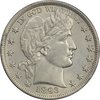
The obverse of the Barber Half Dollar features a right-facing portrait of Liberty with her hair tucked into a Phrygian cap encircled by a laurel wreath. The word LIBERTY appears on a small band above her forehead, while the motto IN GOD WE TRUST is positioned above the portrait. Six stars appear to the left of Liberty, with seven more to the right, and the date is placed below. This dignified representation of Miss Liberty was designed to convey the values of freedom and national pride during a time of significant American expansion and industrial development.
The reverse design evolved through the series, with subtle modifications:
- 1892-1915: An adaptation of the Great Seal of the United States featuring a heraldic eagle grasping an olive branch in its right talon and arrows in its left. The eagle holds in its beak a ribbon inscribed with E PLURIBUS UNUM. A galaxy of stars appears above, while UNITED STATES OF AMERICA and HALF DOLLAR encircle the design.
The coins were struck in 90% silver and 10% copper, weighing 12.5 grams with a diameter of 30.6mm and a reeded edge. The mintmark, when present, appears on the reverse below the eagle's tail feathers and above the D in DOLLAR. Four mints produced these coins: Philadelphia (no mintmark), Denver (D), New Orleans (O), and San Francisco (S).
Varieties & Key Dates
While the Barber Half Dollar series contains no extreme rarities that are completely unobtainable, several dates stand out as particularly scarce and desirable to collectors. The 1892-O, struck during the inaugural year with a modest mintage of 390,000, is considered a key date, particularly in higher grades. A notable variety of this issue, the 1892-O Micro O, featuring an unusually small mintmark, is rare and expensive in all grades.
Other significant key dates include the 1892-S, 1893-S, 1896-S, 1897-O, 1897-S, and the later Philadelphia issues of 1913, 1914, and 1915. The final three years saw particularly low mintages, with fewer than 200,000 coins struck each year, making them scarce across all grades. The 1904-S, with only 553,038 coins struck, is another notable scarcity, as many remained undistributed and may have been melted. Similarly, the 1915 Philadelphia issue, with just 138,000 struck as new designs were being prepared, is prized by collectors in all conditions.
Collectors should be aware that New Orleans Mint issues typically display weak strikes in certain areas, particularly at the eagle's left claw, the arrow feathers, and the upper right portion of the shield. Another peculiarity of New Orleans Mint halves is a swelling on Liberty's neck caused by die deterioration, known as "mumps," frequently seen on 1906-O, 1907-O, and 1908-O issues. For those interested in Barber Half Dollar varieties, these mint-specific characteristics provide fascinating collecting opportunities.
Collecting Insights
Barber Half Dollars present a unique challenge to collectors, as they are among the most difficult Barber coin series to complete in decent grades. Having seen heavy circulation during their era, these coins are most commonly found in lower grades (Good to Very Good), while examples in Fine and better conditions are increasingly scarce. The grades of Fine through Extra Fine (EF) are particularly sought after by date and mint collectors, and specimens with natural, undisturbed surfaces are in high demand.
When grading Barber Half Dollars, pay special attention to the obverse headband with LIBERTY, which is a high-profile area subject to wear. In higher grades, all letters of LIBERTY should be visible and bold. On the reverse, examine the eagle's breast feathers and wing details, as these areas often show the first signs of wear. Note that Barber halves frequently display striking differences in preservation between obverse and reverse, with the overall grade defaulting to the lower condition side.
Collector-quality specimens command significant premiums, with examples ranging from common dates in circulated condition to well-preserved pieces and key dates. For collectors and investors, it's worth noting that as time passes, fewer Barber Half Dollars remain available on the market, with even fewer preserved in excellent condition, suggesting potential for continued appreciation in value. Many collectors also pursue the complete Barber coin series as a unified collecting goal, combining dimes, quarters, and half dollars from this classic era.
Frequently Asked Questions
What makes Barber Half Dollars valuable to collectors?
Barber Half Dollars derive their value from multiple factors: their 90% silver content, historical significance, relatively short production period, and scarcity in higher grades. The condition of the coin, specific date and mintmark combination, and overall aesthetic appeal all contribute to a specimen's desirability and market value.
How can I tell if my Barber Half Dollar is authentic?
Authentic Barber Half Dollars should have the correct weight (12.5g), diameter (30.6mm), and reeded edge. Be wary of coins with unusual wear patterns, incorrect mint marks, or those that appear to have been altered. Key dates are occasionally counterfeited or altered from common dates, so having valuable specimens authenticated by a reputable coin dealer or third-party grading service is recommended.
Which Barber Half Dollars should I look for when starting a collection?
Beginners might start with common dates in Good to Very Good condition, which are relatively affordable and accessible. As your collection grows, you can pursue scarcer dates and better conditions. The series has 73 date/mintmark combinations, with most being obtainable in lower grades at reasonable prices—only about 9 of the 73 cost more than $100 in G4 condition.
How does condition affect the value of Barber Half Dollars?
Condition dramatically impacts value, particularly for Barber Half Dollars, which are notoriously difficult to find in higher grades. A common date might be worth just its silver value in heavily worn condition but could command 40 times that amount in well-preserved states. Additionally, coins with original, undisturbed surfaces typically command premium prices compared to cleaned or damaged examples.
Are Barber Half Dollars a good investment?
While no investment is guaranteed, Barber Half Dollars offer several appealing attributes: intrinsic silver value providing a price floor, decreasing supply as coins are absorbed into collections, and historical significance that maintains collector interest. Common dates track with silver prices, while scarcer issues and high-grade specimens tend to appreciate independently of metal values over time.
How should I store and handle my Barber Half Dollar collection?
Never clean your coins, as this can substantially reduce their value. Store them in archival-quality holders that don't contain PVC or other harmful chemicals. Handle coins by their edges, avoiding touching the surfaces, which can leave oils and fingerprints that may damage the coin over time. For valuable specimens, consider professional grading and encapsulation for protection and authentication.
What's the difference between bullion-quality and collector-quality Barber Half Dollars?
Bullion-quality coins are those valued primarily for their silver content, typically heavily worn common dates whose prices fluctuate with silver market values. Collector-quality coins, generally those in Fine condition or better with clear design details, command premiums above their silver value due to their numismatic desirability, rarity, and aesthetic appeal.
Discover Quality, History-Rich Coins at L&C Coins
L&C Coins is a family-owned and operated business founded by coin enthusiast Lee Crane. Since 1974, we've offered our loyal customers a diverse selection of authentic and rare coins at a variety of price points to suit collectors of all levels.
In addition to a history-rich collection of both certified and uncertified coins, you'll enjoy free shipping with every standard order and free express shipping for orders of $25 or more. Should you have any questions, don't hesitate to contact our team of experts — we're here to help.