
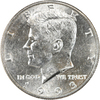
Kennedy Half Dollars
Kennedy Half Dollars
First minted in 1964, the Kennedy half dollar is a fifty-cen t coin created as a memorial to John F. Kennedy — the assasinated 35th president of the United States. This coin replaced the Franklin half dollar, and versions of the coin created in 1964 contained 90% silver before the amount was reduced to 40% for coins created from 1965-1970. While production of these half dollars for general circulation ended in 2001, production continued for collectors and new 2021 coins are now being produced for general circulation.
Explore L&C Coins’ wide variety of copper and silver Kennedy Half Dollars today and find the perfect addition to your new or growing collection.
Origin & History
The Kennedy Half Dollar was born from tragedy, conceived as a lasting memorial following President John F. Kennedy's assassination on November 22, 1963. Within hours of this national tragedy, discussions began about creating a coin to honor the fallen president. By November 27, just five days after Kennedy's death, Mint Director Eva Adams had contacted Chief Engraver Gilroy Roberts to begin designing the new half dollar. Congress swiftly passed legislation authorizing the coin's creation on December 30, 1963, replacing the Franklin Half Dollar that had been in circulation since 1948.
The Kennedy Half Dollar's design was developed with remarkable speed, as the nation mourned. Chief Engraver Roberts adapted his existing Kennedy presidential medal design for the coin's obverse, while Assistant Engraver Frank Gasparro created the reverse featuring the presidential seal. First Lady Jacqueline Kennedy personally reviewed the designs, suggesting subtle modifications to her husband's portrait.
Production began in January 1964, with the first coins struck on February 11, 1964. Public demand proved overwhelming when the coins were released on March 24, 1964. Long lines formed at banks across the country, and the initial mintage of 70 million coins quickly disappeared from circulation, hoarded by Americans as mementos of their beloved president. This phenomenon would continue throughout the series' history, with many Kennedy halves removed from circulation and preserved by both collectors and non-collectors alike, creating an unusual dichotomy—a circulating coin that rarely circulated.
Design Elements
The Kennedy Half Dollar's obverse features a left-facing profile portrait of President Kennedy, creating a dignified and powerful memorial. Designed by Chief Engraver Gilroy Roberts, the portrait shows exceptional detail in Kennedy's hair, facial features, and the subtle shading that conveys both youth and gravitas. The inscription "LIBERTY" appears above the portrait, with the motto "IN GOD WE TRUST" divided on either side of Kennedy's neck. The date is positioned at the bottom of the obverse. Roberts' initials "GR" appear on the truncation of Kennedy's neck, just below the tip of the collar.
The reverse design, created by Assistant Engraver Frank Gasparro, has evolved through several variations:
- 1964-present: The Presidential Seal forms the central design, featuring an eagle with outstretched wings, clutching an olive branch and arrows. The eagle's breast bears a shield with 13 stripes, representing the original states. Above the eagle is a semicircular arrangement of 50 stars, while the motto "E PLURIBUS UNUM" appears on a ribbon held in the eagle's beak. "UNITED STATES OF AMERICA" and "HALF DOLLAR" encircle the design. Gasparro's initials "FG" appear on the right side below the eagle's tail feathers.
- 1965-1969: The reverse design remained the same, but with reduced silver content (40% instead of 90%), resulting in a slightly different appearance and feel.
- 1971-present: The same basic design continued after silver was removed entirely, with the coins now composed of copper-nickel clad.
- 1976: Special Bicentennial reverse design featuring Independence Hall in Philadelphia replaced the Presidential Seal for this year only, with dual-dating "1776-1976" on the obverse.
Kennedy Half Dollars measure 30.6mm in diameter and 2.15mm in thickness. The mint marks are located on the obverse below Kennedy's portrait (from 1968 onward) or on the reverse above the "HALF DOLLAR" inscription (1964-1967). Authentic specimens display crisp details in Kennedy's hair, the eagle's feathers, and properly formed serifs on the lettering.
Varieties & Key Dates
The Kennedy Half Dollar series offers collectors several scarce issues and fascinating varieties that enhance its collecting appeal. The most notable key date is undoubtedly the 1970-D, with its unusually low mintage of just 2.15 million coins. This date was produced exclusively for mint sets and not released for general circulation, making it the scarcest regular-issue Kennedy half. In uncirculated condition, these coins command a significant premium.
The inaugural 1964 Kennedy halves hold special significance as the only 90% silver issues in the series. Both Philadelphia and Denver strikes are readily available, though high-grade specimens with full luster remain in demand. The 1964 Accented Hair variety, featuring enhanced hair details over Kennedy's ear, represents an early die modification and carries premium value, especially in proof condition.
Among proof issues, the 1964 proof strikes are particularly prized for their 90% silver content and historical significance as first-year issues. The 1998-S matte finish proof, with its distinctive satin-like appearance and limited mintage of just 62,350, has become one of the most valuable modern Kennedy halves.
Several special strike formats present collecting opportunities, including the Special Mint Set (SMS) issues of 1965-1967, which feature a distinctive finish between business strike and proof quality. The 1966 SMS half dollar is particularly elusive in top grades. The 1976 Bicentennial issues, featuring the Independence Hall reverse design by Seth Huntington, were produced in both copper-nickel and 40% silver compositions, with the silver versions included only in special collector sets.
Notable Kennedy Half Dollar varieties include the 1972-D doubled die obverse, showing distinct doubling on the inscriptions, and the 1974-D doubled die obverse with doubling visible on Kennedy's profile. The 1979-S and 1981-S proof issues exist in both Type 1 (filled S) and Type 2 (clear S) mint mark varieties, with the Type 2 versions typically commanding higher prices.
For modern issues, the 1998-S, 2011-P, and 2014-W 50th Anniversary gold half dollar represent significant collectibles. The 2014 50th Anniversary silver issues, with their special enhanced finish, have also attracted strong collector interest since their release.
Collecting Insights
Building a meaningful Kennedy Half Dollar collection requires understanding the factors that distinguish ordinary specimens from truly desirable examples. Condition plays a crucial role, particularly for circulation strikes from 1964-1970, as most were saved rather than spent, resulting in an abundance of uncirculated coins. However, truly pristine examples with full mint luster and minimal bag marks remain relatively scarce, especially for the 40% silver issues of 1965-1970.
Strike quality varies considerably throughout the series. Many Kennedy halves, particularly those from the 1970s, exhibit weakness in the central hair details and the eagle's breast feathers. When evaluating potential purchases, examine these areas carefully, as strong strikes command premium prices among knowledgeable collectors. Look for complete definition in Kennedy's hair over the ear and sharp definition in the eagle's wing feathers and breast shield.
For silver issues (1964-1970), toning can significantly impact desirability and value. Original, naturally toned specimens with rainbow or deep peripheral coloration are highly prized, while artificial or unattractive toning can diminish value. Be wary of cleaned or polished coins, which will show hairline scratches and unnatural brightness under proper lighting.
Kennedy Half Dollars are typically collected in several ways: by date and mint mark, by type (silver, clad, proof, special finish), or by focusing on specific years like the Bicentennial issues. For beginners, we recommend starting with a basic date and mint set of business strikes, which can be completed affordably except for the 1970-D. Many collectors also pursue complete half dollar type sets that include Walking Liberty, Franklin, and Kennedy designs, or focus on assembling a comprehensive type coin collection spanning American numismatic history. Browse L&C Coins' selection of Kennedy halves to find quality examples that match your collecting goals, all backed by our expertise and 15-day return privilege.
Frequently Asked Questions
Why are Kennedy Half Dollars rarely found in circulation today?
Kennedy Half Dollars became scarce in circulation almost immediately after their 1964 introduction due to several factors. First, many Americans saved them as mementos of the beloved president. Additionally, rising silver prices in the late 1960s led to hoarding of the 90% (1964) and 40% (1965-1970) silver issues. After 1971, when silver was removed entirely, the denomination simply became less practical for everyday transactions. By the 2000s, production was reduced significantly, with most new Kennedy halves going directly to collectors rather than into circulation channels. Today, banks can still order them, but they rarely reach everyday commerce.
What is the silver content of Kennedy Half Dollars?
Kennedy Half Dollars have had varying silver content throughout their production. The 1964 issues contain 90% silver and 10% copper, with 0.36169 troy ounces of pure silver. From 1965 through 1970, the composition changed to 40% silver (outer layer bonded to a copper core), containing 0.1479 troy ounces of silver. From 1971 onward, regular business strikes contain no silver, being composed of copper-nickel clad (75% copper, 25% nickel outer layers bonded to a pure copper core). However, 90% silver Kennedy halves were offered annually from 1992-2018. From 2019-now they changed the composition to 99.9% silver with the 1976 Bicentennial sets including only 40% silver.
What makes the 1970-D Kennedy Half Dollar so valuable?
The 1970-D Kennedy Half Dollar's value stems from its unusually low mintage of just 2.15 million coins. Unlike other dates, it was struck exclusively for inclusion in mint sets and was never released for general circulation. Additionally, as one of the final 40% silver Kennedy halves produced, it holds extra appeal for collectors seeking to complete silver Kennedy sets. In uncirculated condition, these coins sell for significant premiums over their silver content, with professionally graded MS65 or better examples commanding several hundred dollars. This combination of low mintage, silver content, and limited distribution makes it the key date in the regular Kennedy half series.
What is the "Accented Hair" variety of the 1964 Kennedy Half Dollar?
The "Accented Hair" variety is an early die variation of the 1964 Kennedy Half Dollar, primarily found in proof specimens. It features more pronounced striations in Kennedy's hair, particularly above and behind his ear, giving the hair a sharper, more detailed appearance. According to Mint records, Jacqueline Kennedy objected to this initial design, feeling it overemphasized her late husband's hair. In response, Chief Engraver Gilroy Roberts modified the dies to soften these details. The "Accented Hair" variety was produced for only a short time before the revised design was implemented, making these early strikes relatively scarce and desirable to collectors, typically commanding a premium of 40-100% over standard 1964 proofs.
Are there any valuable errors in the Kennedy Half Dollar series?
Yes, several valuable errors exist in the Kennedy Half Dollar series. Among the most notable are doubled die varieties, particularly the 1972-D doubled die obverse showing doubling on lettering and date, which can sell for hundreds of dollars in high grade. Off-metal errors, such as Kennedy halves struck on quarter planchets, are rare and valuable. "No FG" varieties, where Frank Gasparro's initials are missing from the reverse due to die polishing, exist for several dates including 1972-D and 1982-P. Perhaps most valuable are transitional errors from 1964-65 and 1970-71, where coins were struck on the wrong composition planchets during years when the metallic content changed, with some examples selling for thousands of dollars when properly authenticated.
How can I determine if my Kennedy Half Dollar is silver?
Several methods can help identify silver Kennedy Half Dollars. First, check the date: all 1964 Kennedy halves are 90% silver, while those dated 1965-1970 contain 40% silver. Those from 1971 onward are generally copper-nickel clad unless specifically produced as silver collector issues. Visually, silver Kennedys typically have a slightly different color than clad issues, appearing more gray than the yellowish tint of copper-nickel coins. The edge provides another clue: 90% silver coins show a solid silver edge, 40% silver issues display a thin silver layer sandwiching a copper core, while clad coins show a distinctive copper center between silver-colored outer layers. Finally, silver coins weigh slightly more than clad ones, with a 90% silver half weighing 12.5 grams versus 11.5 grams for a clad half dollar.
Discover Quality, History-Rich Coins at L&C Coins
L&C Coins is a family-owned and operated business founded by coin enthusiast Lee Crane. Since 1974, we've offered our loyal customers a diverse selection of authentic and rare coins at a variety of price points to suit collectors of all levels.
In addition to a history-rich collection of both certified and uncertified coins, you'll enjoy free shipping with every standard order and free express shipping for orders of $25 or more. Should you have any questions, don't hesitate to contact our team of experts — we're here to help.