
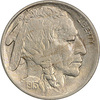
Buffalo Nickels
Buffalo Nickels (1913-1938)
The Buffalo nickel stands as one of America's most beloved and distinctively American coin designs. Minted from 1913 to 1938, these iconic five-cent pieces capture the spirit of the American West with their bold depictions of a Native American chief on the obverse and an American bison on the reverse. Designed by renowned sculptor James Earle Fraser, Buffalo nickels represent a departure from European-influenced designs toward truly American artistic expression.
Their rugged beauty, historical significance, and challenging collecting opportunities have made them perennial favorites among both beginning and advanced numismatists. From the scarce 1913 Type 1 to the legendary 1937-D Three-Legged Buffalo, these coins offer fascinating varieties that continue to captivate collectors more than a century after their introduction.
Origin & History
The Buffalo nickel emerged during a renaissance in American coin design championed by President Theodore Roosevelt, who sought to beautify the nation's coinage. The Liberty Head or "V" nickel, which had been produced since 1883, was due for replacement after 25 years of production. Mint Director Frank Leach commissioned renowned sculptor James Earle Fraser to design the new five-cent piece in 1911, seeking a distinctly American motif that would capture the spirit of the nation.
Fraser, a student of Augustus Saint-Gaudens, drew inspiration from his western upbringing and familiarity with Native American subjects. For the obverse, he created a composite portrait drawn from several Native American chiefs who had sat for him, including Iron Tail (Sioux), Two Moons (Cheyenne), and Chief John Big Tree (Seneca). The reverse featured an American bison (commonly called a buffalo), modeled after "Black Diamond," a resident of New York's Central Park Zoo.
Production began in February 1913, but the design soon revealed practical problems. The date and denomination, placed on raised areas of the design, wore away quickly in circulation. By late 1913, the Mint modified both sides to recess these critical elements, creating the Type 2 variant. Despite these changes, the Buffalo nickel remained problematic, with weak strikes and rapid wear in circulation throughout its production run.
The Buffalo nickel was eventually replaced by the Jefferson nickel in 1938 after its minimum 25-year term, leaving behind a legacy as one of America's most artistically significant and culturally representative coin designs.
Design Elements
The Buffalo nickel's obverse features a dignified profile of a Native American chief facing right. The portrait shows remarkable detail in the facial features, with strong cheekbones, a prominent nose, and textured hair adorned with braids and feathers. The word "LIBERTY" appears along the upper right rim, while the date is positioned at the lower right base of the neck. Fraser's initial "F" is subtly placed below the date on most issues. The design conveys a sense of pride and nobility, representing the indigenous peoples who played such a significant role in American history.
The reverse design evolved during the coin's production:
- 1913 Type 1 (February-May 1913): The initial design featured a full-bodied buffalo standing on a raised mound. The denomination "FIVE CENTS" appeared on this raised area, along with "UNITED STATES OF AMERICA" above the buffalo and "E PLURIBUS UNUM" below the mound. This design proved impractical as the raised mound area wore quickly in circulation.
- 1913-1938 Type 2 (May 1913-1938): The redesigned reverse featured a recessed area below the buffalo where "FIVE CENTS" was protected from wear. The ground line was flattened, and overall relief was slightly reduced to address striking issues. This version continued until the end of the series in 1938.
Buffalo nickels measure 21.2mm in diameter and 1.95mm in thickness, with a weight of 5 grams. They were struck in an alloy of 75% copper and 25% nickel. Mint marks, when present, appear on the reverse below the denomination on Type 2 coins, or below the mound on Type 1 coins. Authentic specimens display proper proportions and details, including the texture of the buffalo's hide and the intricate feathers in the Native American's headdress.
Varieties & Key Dates
Buffalo nickels present collectors with numerous challenging key dates and fascinating varieties. The series' most famous rarity is undoubtedly the 1937-D "Three-Legged" Buffalo, created when a mint employee over-polished a damaged die, removing most of the buffalo's right front leg. Despite being a mint error, this variety has achieved legendary status, commanding prices from $500 in heavily worn condition to over $50,000 for pristine uncirculated examples.
Among regular issues, the 1913-S Type 2 stands as a key date with only 1.2 million minted. The 1921-S represents another condition rarity, as most were poorly struck and heavily circulated, making well-defined specimens especially valuable. The 1924-S and 1926-S are similarly challenging, with the latter having the lowest mintage of the series at just 970,000 coins.
Early dates from the San Francisco Mint (1913-S, 1914-S, 1915-S) are particularly scarce in higher grades, while the 1918/7-D overdate—where a 1918 date was punched over a 1917 die—remains one of the most valuable Buffalo nickel varieties, often commanding five-figure prices in better conditions.
Other notable varieties include the 1916 Doubled Die Obverse, showing dramatic doubling on the date and "LIBERTY," and the 1935 Doubled Die Reverse with doubling visible on "E PLURIBUS UNUM" and other elements. The 1936-D "3½ Legs" variety, less dramatic than its famous 1937 counterpart, shows partial weakness in one leg and deserves attention from variety specialists.
For those collecting by mint, Denver and San Francisco issues typically command premiums over their Philadelphia counterparts, particularly in higher grades. Proofs were struck only from 1913 to 1916 and again in 1936 and 1937, with the matte proofs of 1913-1916 being particularly rare and desirable, often selling for $25,000 or more when available.
The Buffalo nickel series also includes many repunched mint marks and minor varieties that appeal to specialists seeking a deeper collecting challenge beyond the standard date and mint collection.
Collecting Insights
Building a quality Buffalo nickel collection requires understanding the unique challenges this series presents. Strike quality varies dramatically across the series, with many dates exhibiting weakness in central details—particularly the buffalo's head and shoulder, and the Native American's cheekbone and feathers. When evaluating potential purchases, examine these high points carefully, as strong strikes command significant premiums, especially on notoriously weak issues like the 1925-D and 1926-D.
Authenticity concerns are paramount when considering key varieties like the 1937-D Three-Legged Buffalo and the 1918/7-D overdate. Altered coins abound, with fraudulent examples created by removing details from genuine coins. Working with a reputable dealer like L&C Coins ensures proper authentication of these valuable varieties.
Grading Buffalo nickels presents unique challenges due to their design and wear patterns. The date, often the first feature to wear away, creates a population of "dateless" Buffalos that can sometimes be recovered using date restoration solutions (though these are considered altered coins with limited collector value). When assessing grade, focus on the high points—the Native American's cheekbone and hairline on the obverse, and the buffalo's shoulder and hip on the reverse—as these areas show wear first.
For collectors beginning their Buffalo nickel journey, consider starting with a date-and-mint collection of the more common issues from the 1920s and 1930s in Good to Fine condition, gradually adding better dates as your budget allows. Many collectors also pursue complete type coin collections that include Buffalo nickels alongside other classic American designs like Morgan dollars and Lincoln cents. Browse L&C Coins' selection of properly graded Buffalo nickels to find examples that match your collecting goals, all backed by our expertise and free shipping on every order.
Frequently Asked Questions
Which Buffalo nickels are the most valuable?
The most valuable Buffalo nickels include the 1937-D Three-Legged Buffalo, which can be worth $500-$50,000 depending on condition; the 1918/7-D overdate, valued at $5,000-$100,000; and the low-mintage 1926-S, worth $500-$25,000 in collectible grades. Proof issues from 1913-1916 also command premium prices, often exceeding $25,000 for well-preserved specimens. The value of any Buffalo nickel depends on its condition, with uncirculated examples commanding significant premiums.
How can I tell if my 1937-D Three-Legged Buffalo is authentic?
Authentic 1937-D Three-Legged Buffalos display specific characteristics: the right front leg is completely missing, but the hoof remains visible on the ground line; the buffalo's shoulder shows a distinctive "moth-eaten" appearance where the die was over-polished; and the reverse shows proper mint luster and strike quality consistent with other 1937-D issues. Because this valuable variety is frequently counterfeited, purchasing only authenticated examples from reputable dealers like L&C Coins or having your coin certified by PCGS or NGC is highly recommended.
What caused the date to wear off Buffalo nickels so quickly?
The date on Buffalo nickels wore away rapidly because of its raised position on the design combined with the coin's high relief. On Type 1 (1913) coins, the date was placed on a raised area with little protection from circulation wear. Although the Type 2 redesign attempted to address this issue, the date remained vulnerable. The five-cent denomination saw heavy circulation, and the copper-nickel alloy used was relatively soft. These factors combined to create the notorious problem of "dateless" Buffalo nickels, which represent a substantial percentage of surviving examples.
Are dateless Buffalo nickels worth anything?
Dateless Buffalo nickels generally have minimal numismatic value, typically worth only a fraction of their value with visible dates. However, even without dates, they retain appeal as affordable examples of American artistic design. Some collectors assemble "type sets" using dateless examples, particularly for the more expensive key dates. While chemical solutions exist to restore dates, coins treated this way are considered altered and not valued by serious collectors. For investment and collecting purposes, focus on specimens with naturally visible dates.
How did James Earle Fraser create the Native American portrait on the Buffalo nickel?
James Earle Fraser created the Native American portrait as a composite drawn from several Indigenous chiefs who sat for him. While Fraser identified Iron Tail (Sioux), Two Moons (Cheyenne), and Chief John Big Tree (Seneca) as his primary models, the exact combination remains somewhat ambiguous by the artist's own account. Rather than representing a specific individual, Fraser intended the portrait to embody the dignity and spirit of Native American peoples collectively. The resulting design is considered one of the most artistically significant portraits in American numismatic history.
Why was the Buffalo nickel replaced in 1938?
The Buffalo nickel was replaced in 1938 primarily because it had fulfilled its minimum 25-year statutory production requirement, allowing for a design change without special congressional approval. The Mint welcomed the opportunity to replace a design that had proven problematic from production and circulation standpoints. The raised features wore quickly, dates became illegible, and the high-relief design caused striking difficulties throughout its production. The Jefferson nickel introduced in 1938 featured a more durable, lower-relief design that addressed many of these technical issues.
Discover Quality, History-Rich Coins at L&C Coins
L&C Coins is a family-owned and operated business founded by coin enthusiast Lee Crane. Since 1974, we've offered our loyal customers a diverse selection of authentic and rare coins at a variety of price points to suit collectors of all levels.
In addition to a history-rich collection of both certified and uncertified coins, you'll enjoy free shipping with every standard order and free express shipping for orders of $25 or more. Should you have any questions, don't hesitate to contact our team of experts — we're here to help.