Liberty Nickels
Liberty Nickels (1883-1913)
The Liberty Head nickel, often called the "V nickel" for its distinctive reverse, represents an elegant chapter in American numismatic history. Minted from 1883 to 1913, these classic coins showcase Charles Barber's artistry and capture a pivotal era of American growth and change. The series features several fascinating varieties, including the infamous 1883 "No Cents" issue and extraordinarily rare 1913 specimens.
With accessibility for beginning collectors and challenging key dates for advanced numismatists, Liberty nickels offer both historical significance and collecting appeal. Whether you're assembling a type collection or pursuing a complete date set, these iconic five-cent pieces provide an engaging window into late 19th and early 20th century American coinage.
Origin & History
The Liberty Head nickel emerged from practical necessity and artistic evolution in the early 1880s. After 17 years of production, the Shield nickel (1866-1883) had proven problematic at the Mint, with its intricate design causing striking difficulties throughout its run. In 1881, Mint Director Archibald Loudon Snowden instructed Chief Engraver Charles Barber to create new designs for the one-cent, three-cent, and five-cent coins, aiming for uniformity across denominations.
Though only Barber's five-cent design was ultimately approved, the Liberty Head nickel represented a significant aesthetic improvement over its predecessor. Production began at the Philadelphia Mint on January 30, 1883, with the coins entering circulation on February 1 of that year. The initial design featured no denomination beyond the Roman numeral "V" on the reverse—an oversight that would quickly prove problematic.
Enterprising individuals soon realized that the new coins were similar in size to the five-dollar gold piece. By gold-plating the nickels and sometimes adding fraudulent edge reeding, they could pass them off as five-dollar coins. This deception prompted the Mint to modify the design just months after its introduction, adding the word "CENTS" to the reverse. Both varieties of 1883 nickels (with and without "CENTS") are collected today, with the short-lived "No CENTS" variety maintaining special historical interest.
The Liberty nickel was produced continuously through 1912, with mintage for the series ending that year. However, five specimens dated 1913 exist, created under mysterious circumstances that have fueled collector fascination for generations. By 1913, the design had been officially replaced by James Earle Fraser's iconic Buffalo nickel.
Design Elements
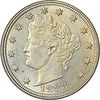
The Liberty Head nickel obverse features a leftward-facing portrait of Liberty, designed by Charles Barber to project classical dignity. Liberty wears a coronet inscribed with the word "LIBERTY," while her hair is bound with a wreath of cotton, corn, wheat, and maple leaves—agricultural products representing America's bounty. Thirteen stars encircle the bust, symbolizing the original colonies, with the date positioned at the bottom. The overall design evokes the neoclassical aesthetic popular during the late 19th century, with clean lines and balanced proportions.
Barber created the same classical Liberty portrait for the Barber dime, quarter, and half dollar introduced in 1892, creating a unified aesthetic across silver denominations that would continue for over two decades.
The nickel's distinctive reverse design evolved during its production:
- 1883 Type 1 (No CENTS): The initial reverse featured a large Roman numeral "V" centered within a wreath of corn, cotton, and wheat. The inscription "UNITED STATES OF AMERICA" arcs along the top edge, while "E PLURIBUS UNUM" appears in a banner across the wreath. This design lacked any written denomination, creating the vulnerability exploited by gold-platers.
- 1883-1913 Type 2 (With CENTS): The revised design added the word "CENTS" at the bottom of the reverse, while moving "E PLURIBUS UNUM" to the top of the wreath. This modification clarified the coin's denomination and ended the fraudulent gold-plating scheme. This design remained consistent through the end of the series.
Liberty nickels measure 21.2mm in diameter and weigh 5.0 grams. They were struck in an alloy of 75% copper and 25% nickel, which gives them their distinctive silver-like appearance. The Philadelphia Mint struck the vast majority of the series with no mint mark, while the Denver (D) and San Francisco (S) mints produced coins only in 1912, with their respective mint marks appearing on the reverse below the denomination.
Varieties & Key Dates
The Liberty nickel series offers several important key dates and varieties that create both challenges and excitement for collectors. The most famous rarity is undoubtedly the 1913 Liberty Head nickel—with only five specimens known to exist, all believed to have been struck clandestinely. These coins rank among the most valuable in American numismatics, with specimens selling for millions when they appear at auction. However, most collectors focus on the regular-issue dates from 1883 to 1912.
Among the regular issues, the 1885 stands as the undisputed key date with a mintage of just 1,473,300 coins. Despite this seemingly substantial number, few were saved, and examples in any condition command significant premiums. Even in Good condition, an 1885 Liberty nickel typically trades for several hundred dollars, while uncirculated specimens can reach five figures. The 1886 follows as the second scarcest date with just 3,326,000 minted. Economic depression and the Treasury Department's reissuance of older coins kept mintages low for both years.
The 1912-S holds special significance as the only San Francisco issue in the series and the lowest regular-issue mintage at just 238,000 coins. As the first Liberty nickels struck at a branch mint, these coins were produced for only a brief period in late December 1912, making well-preserved examples particularly desirable. The 1912-D also deserves collector attention as Denver's sole contribution to the series.
Additional semi-key dates include the 1894, 1896, and 1901, which had relatively low mintages and are challenging to find in higher grades. For variety collectors, the series offers the 1883 No CENTS and With CENTS types, along with repunched dates and other minor varieties. The 1883 "Racketeer" nickel—a gold-plated example of the No CENTS variety—represents a fascinating historical curiosity, though most examples seen today are modern reproductions rather than genuinely circulated counterfeits.
Collecting Insights
Building a Liberty nickel collection presents unique challenges and rewards for numismatists at every level. When evaluating these historic coins, condition is paramount, as most surviving examples show significant wear from decades of circulation. Pay particular attention to Liberty's coronet, especially the letters in "LIBERTY"—in higher grades, all letters should be clearly visible, while in lower grades, some or all may be worn away. On the reverse, examine the wreath details and the clarity of the "V" for signs of wear.
Most Liberty nickels naturally acquire a gray or light olive patina over time. Specimens with attractive, original surfaces command premiums, while cleaned or damaged coins typically sell at substantial discounts. Artificial toning and environmental damage can significantly reduce value, so study surface characteristics carefully before purchasing. When possible, acquire coins certified by reputable third-party grading services like PCGS or NGC to ensure authenticity and accurate grading.
For beginning collectors, consider starting with common dates from the early 1900s in Good to Fine condition, which remain relatively affordable. As your knowledge and budget grow, gradually add better dates and higher-grade specimens. Many collectors initially pursue a type set consisting of the 1883 No CENTS and With CENTS varieties before attempting a complete date set. Others focus on specific years or mint marks that hold personal significance.
Browse L&C Coins' inventory of Liberty nickels to discover specimens properly graded according to ANA standards. Our family-owned business brings over 40 years of numismatic expertise to help you build an outstanding collection. All purchases include free shipping and our 15-day return privilege, ensuring your complete satisfaction.
Frequently Asked Questions
What makes the 1913 Liberty nickel so valuable?
The 1913 Liberty nickel's extraordinary value stems from its extreme rarity and mysterious origins. Only five examples are known to exist, all believed to have been struck secretly at the Philadelphia Mint after the design had been officially discontinued. These nickels were not discovered publicly until 1920, creating an intriguing numismatic mystery that has fascinated collectors for generations. The combination of rarity, quality, and captivating backstory has driven prices into the millions, with one specimen selling for $4.56 million in 2018.
How can I tell the difference between the 1883 No CENTS and With CENTS varieties?
The distinction is straightforward—examine the reverse (tails side) of the coin. The No CENTS variety shows only the large Roman numeral "V" surrounded by a wreath, with no denomination spelled out. The With CENTS variety displays the word "CENTS" at the bottom of the coin below the wreath. Additionally, the No CENTS variety has "E PLURIBUS UNUM" positioned at the bottom of the coin, while the With CENTS version moves this motto to the top of the wreath. Both varieties were produced in 1883, making it the only year with two distinct reverse designs.
What are "Racketeer Nickels" and are they valuable?
Racketeer Nickels are 1883 No CENTS Liberty nickels that were gold-plated to pass them off as $5 gold pieces in the late 19th century. Authentic period examples that actually circulated as counterfeits are extremely rare and historically significant. Most gold-plated 1883 nickels seen today are modern novelties created for collectors, with minimal premium value. Genuine Racketeer Nickels from the 1880s would show appropriate circulation wear and toning consistent with their age, though authentication by experts is required due to the ease of modern replication.
Why are 1885 and 1886 Liberty nickels so scarce compared to other dates?
The scarcity of 1885 and 1886 Liberty nickels resulted from economic conditions and Treasury policy. An economic downturn in the mid-1880s reduced demand for minor coinage, leading to lower mintage figures. Additionally, the Treasury Department's decision to reissue large quantities of worn coins further depressed new production. With only 1.47 million 1885 nickels and 3.33 million 1886 nickels struck—compared to 16+ million in some later years—these dates became naturally scarce. Few were saved by collectors at the time, making well-preserved examples particularly elusive today.
How should I store and handle my Liberty nickels?
Liberty nickels should be stored in archival-quality holders free from PVC and other harmful chemicals. Avoid touching the coins directly; instead, handle them by their edges while wearing cotton gloves or using coin tongs with nylon tips. Store your collection in a cool, dry environment away from temperature fluctuations, humidity, and direct sunlight. Never clean your Liberty nickels—even those with natural toning or seemingly dirty surfaces—as cleaning severely diminishes collector value. For valuable specimens, consider professional third-party grading services, which encapsulate coins in inert holders that provide both authentication and protection.
What should I look for when grading Liberty nickels?
When grading Liberty nickels, focus on these key areas: on the obverse, examine Liberty's cheek, hair details, and the letters in "LIBERTY" on the coronet; on the reverse, check the definition of the wreath elements and the clarity of the "V." For higher-grade coins, look for signs of original mint luster in protected areas. Be wary of specimens with unnatural shine (indicating cleaning), significant contact marks, or environmental damage. The stars surrounding Liberty often show wear first, providing useful grading indicators. Remember that the series typically struck up weakly in certain areas, so strike quality—separate from wear—must also be evaluated when determining grade.
Discover Quality, History-Rich Coins at L&C Coins
L&C Coins is a family-owned and operated business founded by coin enthusiast Lee Crane. Since 1974, we've offered our loyal customers a diverse selection of authentic and rare coins at a variety of price points to suit collectors of all levels.
In addition to a history-rich collection of both certified and uncertified coins, you'll enjoy free shipping with every standard order and free express shipping for orders of $25 or more. Should you have any questions, don't hesitate to contact our team of experts — we're here to help.