Barber Quarters
Barber Quarters
The Barber Quarter, minted from 1892 to 1916, represents one of America's most popular coin series. Designed by Charles E. Barber, the U.S. Mint's sixth Chief Engraver, these silver quarters capture the classical aesthetic of late 19th century American coinage. With their dignified portrayal of Liberty adorned in a cap of freedom and a stunning heraldic eagle reverse, Barber Quarters have captivated collectors for generations.
Whether pursuing rare key dates like the legendary 1896-S and 1901-S issues, hunting mintmark varieties, or simply appreciating their refined artistic merit, collectors treasure these enduring silver quarters for their beauty, historical importance, and the fascinating challenge they present to numismatists of all experience levels.
Origin & History
The Barber Quarter emerged during a pivotal moment in American coinage history. By the late 1880s, the Seated Liberty design that had appeared on quarters since 1838 was widely considered outdated and in need of replacement. In 1890, Mint Director Edward O. Leech, with approval from Treasury Secretary William Windom, announced a public competition to redesign the dime, quarter, and half dollar. The competition promised a $500 prize to the winning design, but imposed strict requirements that many artists found restrictive.
Despite invitations to prominent sculptors Augustus Saint-Gaudens and Daniel Chester French, the competition failed to produce a satisfactory design. In frustration, Leech directed the Mint's Chief Engraver, Charles E. Barber, to create the new designs himself. Drawing inspiration from contemporary French coinage, Barber developed a classically styled Liberty head for the obverse and a heraldic eagle for the reverse.
Production began in January 1892 at the Philadelphia, New Orleans, and San Francisco Mints. The Barber Quarter featured a composition of 90% silver and 10% copper, containing 0.18084 troy ounces of pure silver. This silver content gave the coins intrinsic value beyond their face value—a characteristic that would later lead to widespread hoarding and eventual melting when silver prices rose in the mid-20th century.
After 25 years of production—the minimum required by law before a design could be changed without congressional approval—the Barber Quarter was replaced in 1916 by Hermon MacNeil's Standing Liberty Quarter, concluding a significant chapter in American numismatic history.
Design Elements
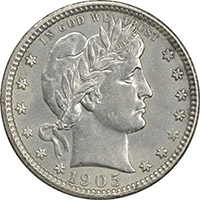
The obverse of the Barber Quarter features a classical right-facing profile of Liberty wearing a Phrygian cap, symbolizing freedom and liberty. Her hair is adorned with a laurel wreath, representing victory, and a small headband inscribed with the word "LIBERTY." Around the top periphery are thirteen stars representing the original colonies, with the mintage date positioned at the bottom. Barber's design achieves a remarkable balance between dignified simplicity and fine detail, particularly in Liberty's flowing hair and the intricate laurel wreath. Barber's initial "B" appears subtly on the truncation of Liberty's neck, though it can be difficult to spot on worn specimens.
The reverse design remained consistent throughout the series:
- 1892-1916: The reverse displays a heraldic eagle with outstretched wings, clutching an olive branch (symbolizing peace) in its right talon and a bundle of arrows (representing military strength) in its left. The eagle's breast bears a shield with thirteen stripes and a chief, representing the original colonies and the federal government. Above the eagle is the national motto "E PLURIBUS UNUM" (Out of Many, One), while "UNITED STATES OF AMERICA" arcs around the top periphery, and "QUARTER DOLLAR" is positioned at the bottom.
The coin measures 24.3mm in diameter and weighs 6.25 grams, with a reeded edge containing 119 reeds. Mint marks, when present, appear on the reverse beneath the eagle. Philadelphia issues carry no mint mark, while "O" denotes New Orleans and "S" signifies San Francisco. Denver ("D") mint marks appear only on 1906-D through 1916-D issues, as the Denver Mint began operations in 1906.
Authentic specimens display proper strike characteristics, including well-defined feathers on the eagle's wings and clear detail in Liberty's hair and wreath. The lettering shows consistent thickness and proper spacing, with denticles (small tooth-like projections) around the rim on both sides that help date the coin's production era.
Varieties & Key Dates
The Barber Quarter series presents collectors with several challenging key dates and fascinating varieties that make assembling a complete set a rewarding pursuit. The undisputed king of the series is the 1901-S, with a mintage of just 72,664 pieces. Even in heavily worn condition, this coin commands thousands of dollars, while examples in uncirculated condition can fetch six-figure prices. The rarity of the 1901-S cannot be overstated—it's generally considered the most valuable regular-issue U.S. quarter struck for circulation in the 20th century.
Following closely behind is the 1896-S, with a mintage of 188,039. Though produced in slightly higher numbers than the 1901-S, the 1896-S is similarly elusive in all grades, particularly in Mint State. Completing the "Big Three" key dates is the 1913-S, with a mintage of 40,000. While not quite as valuable as its two famous counterparts, the 1913-S remains a significant challenge for collectors, especially in higher grades.
Other notable semi-key dates include the 1892-O, 1892-S, 1896-O, 1897-O, 1897-S, 1901-O, 1914-S, and 1915-S. These dates, while not as rare as the "Big Three," still command substantial premiums, particularly in higher grades. The 1909-O holds special significance as the last quarter minted at the New Orleans facility before its closure.
Several interesting varieties exist within the series, including the 1892-O Micro O (featuring an unusually small O mint mark), the 1900-O/CC (an overminmark variety where an O was punched over a CC mint mark), and various repunched dates and mint marks. The 1895-O displays notable die cracks on some examples, creating collectable die varieties for specialists.
Proof Barber Quarters were struck each year at the Philadelphia Mint in limited quantities, typically fewer than 1,000 pieces, making them valuable additions to advanced collections. The 1914 proof, with just 380 struck, is especially prized. While counterfeits of key dates exist, knowledgeable collectors look for proper weight, dimensions, and strike characteristics to authenticate their purchases.
Collecting Insights
Building a meaningful Barber Quarter collection requires understanding the unique challenges and opportunities this series presents. Grading considerations are paramount, as the design's high points—Liberty's hair above the forehead, the eagle's breast and wings—wear quickly in circulation. Even slight differences in condition can significantly impact value, particularly for key dates and better dates.
Most surviving Barber Quarters are found in grades from About Good (AG-3) to Fine (F-12), with examples in Very Fine (VF-20) or better becoming increasingly scarce. For collectors seeking to complete a date and mint mark set, focusing on consistently similar grades creates a more aesthetically pleasing collection than mixing heavily worn examples with higher-grade pieces.
Strike quality varies considerably across the series, with certain issues—particularly those from New Orleans and San Francisco—often displaying weakness in specific areas. Well-struck examples with full detail command substantial premiums, especially for usually weakly struck issues. Mint luster, when present on higher-grade examples, should appear bright and uninterrupted, with no evidence of cleaning or harsh treatment.
Original toning is highly prized on Barber Quarters, with naturally toned examples often displaying beautiful rainbow hues or deep peripheral coloration. Artificially toned pieces, by contrast, tend to exhibit unnatural, spotty, or excessively dark coloration and are less desirable among serious collectors.
For those beginning their Barber Quarter journey, consider starting with more common Philadelphia Mint issues from the early 1900s in Good to Very Good condition, gradually working toward the scarcer dates as your experience and budget allow. Many collectors also pursue the complete Barber dime and Barber half dollar series alongside quarters, as Charles Barber designed all three denominations with matching obverse designs. Browse L&C Coins' extensive selection of authenticated Barber Quarters to find examples that match your collecting goals—all purchases come with free shipping and our 15-day return privilege.
Frequently Asked Questions
What makes the 1901-S Barber Quarter so valuable?
The 1901-S Barber Quarter derives its exceptional value from its extremely low mintage of just 72,664 pieces—the lowest in the series. Additionally, most examples entered circulation and remained there for many years, resulting in significant wear. The San Francisco Mint also focused more on producing gold coinage during this period, giving less attention to striking quality for silver coins. These factors combine to make the 1901-S extraordinarily rare in all grades, with even heavily worn specimens commanding thousands of dollars and uncirculated examples reaching six figures.
How can I tell if my Barber Quarter is authentic?
Authentic Barber Quarters should have the correct weight (6.25 grams), diameter (24.3mm), and composition (90% silver). The design elements should show proper strike characteristics, including well-defined feathers on the eagle and clear detail in Liberty's hair. Lettering should have consistent thickness with proper spacing. Denticles (small tooth-like projections) should appear around the rim on both sides. For valuable key dates like the 1901-S and 1896-S, professional authentication from services like PCGS or NGC is recommended, as these dates are frequently counterfeited. L&C Coins offers only authenticated specimens with our 15-day return privilege.
Why do most Barber Quarters show significant wear?
Barber Quarters circulated widely during an era when 25 cents represented significant purchasing power—equivalent to about $8-10 today. The design also features high-relief elements like Liberty's hair and the eagle's breast that quickly showed wear in commerce. Additionally, when the silver value rose in the mid-20th century, better-condition examples were often hoarded or melted, leaving predominantly worn specimens in collectors' hands. The combination of extensive circulation, design vulnerability to wear, and subsequent melting has resulted in most surviving examples showing moderate to significant wear.
What should I look for when grading Barber Quarters?
When grading Barber Quarters, focus on the high points that wear first: Liberty's hair above the forehead and cheek, the word "LIBERTY" on the headband, and the laurel leaves on the obverse; and the eagle's breast feathers, wing tips, and shield details on the reverse. In Good-4 condition, the rim must be complete and the "LIBERTY" headband visible but not necessarily readable. Very Good-8 requires readable "LIBERTY," while Fine-12 shows complete hair details above Liberty's forehead. Very Fine-20 displays partial mint luster and complete detail in Liberty's hair and the eagle's feathers. Uncirculated examples (MS-60 and above) retain full mint luster with no trace of wear, though may show contact marks.
How does the Barber Quarter compare to other Barber coinage?
The Barber Quarter shares its obverse design with the Barber Dime and Barber Half Dollar, all created by Charles E. Barber and minted from 1892 to 1916. While the obverses are nearly identical, the reverse designs differ, with the dime featuring a wreath rather than the eagle found on both the quarter and half dollar. All three denominations have similar rarity patterns, with San Francisco and New Orleans issues generally scarcer than their Philadelphia counterparts. The quarter is considered the most challenging of the three series to complete due to the extreme rarity of key dates like the 1901-S and 1896-S, which have proportionally lower mintages than comparable issues in the dime and half dollar series.
What is the silver content and value of Barber Quarters?
Barber Quarters contain 90% silver and 10% copper, with 0.18084 troy ounces of pure silver per coin. The numismatic value of Barber Quarters typically exceeds their silver content significantly, particularly for scarcer dates and better-condition examples. Common dates in Good condition might sell for $20-30, while key dates like the 1901-S can command thousands even in heavily worn condition. The numismatic premium over silver value reflects the coins' historical significance, scarcity, and strong collector demand.
Discover Quality, History-Rich Coins at L&C Coins
L&C Coins is a family-owned and operated business founded by coin enthusiast Lee Crane. Since 1974, we've offered our loyal customers a diverse selection of authentic and rare coins at a variety of price points to suit collectors of all levels.
In addition to a history-rich collection of both certified and uncertified coins, you'll enjoy free shipping with every standard order and free express shipping for orders of $25 or more. Should you have any questions, don't hesitate to contact our team of experts — we're here to help.