
Standing Liberty Quarters
Standing Liberty Quarters
The Standing Liberty Quarter, minted from 1916 to 1930, represents one of America's most beautiful and artistically significant coin designs. Created by sculptor Hermon A. MacNeil, these quarters emerged during a renaissance in American coinage and captured the spirit of a nation entering the world stage. With Liberty standing proudly holding a shield and olive branch, the design symbolized America's readiness for defense yet preference for peace.
Highly prized for their intricate detail, historical significance, and challenging variety of types and dates, Standing Liberty quarters remain a cornerstone of serious numismatic collections. From the legendary 1916 issue to the "full head" varieties sought by specialists, these iconic quarters continue to captivate collectors with their artistic merit and fascinating history.
Origin & History
The Standing Liberty Quarter was born during a transformative period in American coinage design. By 1915, the Barber quarter had been in circulation for its mandatory 25 years, allowing Treasury Secretary William McAdoo to authorize a design change without congressional approval. This coincided with a broader artistic movement championed earlier by President Theodore Roosevelt to beautify American coinage.
The Treasury Department held a competition for the new quarter design, which sculptor Hermon A. MacNeil won with his classically-inspired Standing Liberty motif. His design reflected America's evolving position on the world stage, particularly as World War I raged in Europe. The protective shield and olive branch held by Liberty symbolized America's desire for peace but readiness for defense—a particularly meaningful message as the U.S. approached its eventual entry into the conflict in 1917.
The first Standing Liberty quarters were struck in December 1916, with only 52,000 produced before year's end. Their limited mintage and late-year release meant few entered circulation initially, creating what would become one of the greatest rarities in 20th-century American coinage. In early 1917, the design was modified to cover Liberty's exposed breast, responding to public concerns about the original design's propriety. A second major redesign occurred later in 1925, recessing the date to prevent rapid wear—creating three distinct types collectors recognize today.
Production continued until 1930 when the Great Depression significantly reduced demand for new coinage. By 1932, the Washington quarter was introduced to commemorate the 200th anniversary of George Washington's birth, permanently replacing the Standing Liberty design after just 15 years of production.
Design Elements
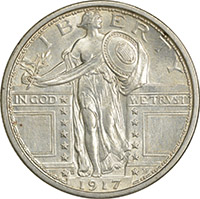
The Standing Liberty quarter's obverse features an elegant depiction of Liberty striding forward through a gateway, representing America stepping onto the world stage. Liberty stands barefoot in a flowing gown, holding a shield in her left hand and an olive branch in her right—symbolizing readiness for defense while preferring peace. Originally, Liberty's right breast was partially exposed in a classical style, while stars flank her figure on both sides. "LIBERTY" appears along the top edge, while the date appears at the bottom. The designer's initial "M" appears to the right of Liberty's right foot.
The reverse design remained relatively consistent throughout the series:
- 1916-1930: An eagle in flight with wings spread, soaring through an open field. "UNITED STATES OF AMERICA" arcs around the top, while "QUARTER DOLLAR" appears at the bottom. The motto "E PLURIBUS UNUM" is positioned above the eagle. Thirteen stars appear in the design, representing the original colonies—seven above the eagle and six below, with the lower stars separated by the denomination.
The Standing Liberty quarter underwent two significant design modifications:
- Type 1 (1916-1917): The original design featured Liberty with a partially exposed breast. The shield has no chain mail covering, and the reverse shows an eagle flying higher in the field.
- Type 2 (1917-1924): Liberty's gown was redesigned to fully cover her breast. Chain mail was added to the shield, symbolizing America's increased military readiness as it entered World War I. The reverse was slightly modified with the eagle positioned lower.
- Type 2a (1925-1930): The date area was recessed into a raised platform to prevent rapid wear, as many circulating coins quickly became dateless. Otherwise, this variety retained the Type 2 design elements.
Standing Liberty quarters measure 24.3mm in diameter, weigh 6.25 grams, and were struck in 90% silver and 10% copper. Mint marks appear on the obverse, just to the left of the date—an arrangement that helps collectors identify specimens even when dates are worn away.
Varieties & Key Dates
The Standing Liberty quarter series presents collectors with several notable rarities and varieties that have achieved legendary status in American numismatics. The undisputed king of the series is the 1916, with its tiny mintage of just 52,000 pieces—the lowest of any 20th century regular-issue silver coin. Even in circulated grades, 1916 quarters command five-figure prices, while mint state examples regularly sell for $25,000 to $100,000 or more, depending on condition and strike quality.
The 1918/7-S overdate stands as another significant rarity. This variety occurred when a 1917 die was repunched with a 1918 date, creating a visible overdate visible under magnification. Often considered the second-rarest coin in the series, it remains challenging to find in any condition, with well-preserved examples commanding premium prices similar to the 1916 issue.
Other key dates include the 1921 and 1923-S, both with relatively low mintages and poor striking characteristics that make high-grade examples particularly elusive. The 1921 had a mintage of only 1.9 million pieces, while the 1923-S, with 1.4 million struck, is notorious for weak strikes that often lack definition in Liberty's head and shield details.
Beyond date rarity, the "Full Head" designation represents a crucial factor in Standing Liberty quarter collecting. Many issues exhibit weak strikes on Liberty's head, with incomplete hair details and facial features. Specimens showing complete detail in Liberty's head command substantial premiums—often three to five times the price of regular strikes. The 1927-S is especially challenging to find with a Full Head, as are the 1920-S, 1924-S, and 1926-D.
Die varieties add another dimension to collecting, with the 1920 showing both a small and large S mint mark. The 1917 Type 1 and Type 2 varieties from all three mints (Philadelphia, Denver, and San Francisco) are necessary for a complete collection, representing the transition between the two major design types. For specialists, Standing Liberty quarter varieties offer numerous attribution opportunities.
For budget-conscious collectors, the series offers many accessible options, with common dates from the mid-to-late 1920s readily available in circulated condition at modest premiums over silver value. Browse L&C Coins' inventory to find Standing Liberty quarters across the spectrum of rarity and condition to match your collecting goals.
Collecting Insights
Building a meaningful Standing Liberty quarter collection requires understanding the series' unique grading challenges and strike characteristics. These coins circulated heavily, with dates frequently worn smooth—particularly on the earlier issues before the 1925 recessed date modification. When evaluating potential purchases, pay special attention to the date area, as many otherwise attractive coins lack this crucial feature.
The "Full Head" designation represents perhaps the most important premium feature in the series. To qualify as Full Head, Liberty's head must show complete detail in three key areas: the hairline at the forehead, the three leaves in Liberty's hair, and the ear indentation. Even on mint state coins, these details are often poorly struck, making true Full Head examples scarce and highly desirable. The 1921, 1923-S, 1927-S, and 1928-S are particularly challenging to find with Full Head detail, often commanding multiples of the price of regular strikes.
Original surfaces are crucial for investment-quality Standing Liberty quarters. Many specimens have been improperly cleaned over the years, destroying their natural luster and significantly reducing their value. Look for coins with original mint luster and natural toning that develops over decades of proper storage. Silver quarters typically tone in attractive hues ranging from champagne to deep blue and russet, often enhancing their eye appeal.
Mint state Standing Liberty quarters are graded on the standard Sheldon scale from MS-60 to MS-70, though few examples exceed MS-66. Strike quality varies significantly even within the same mint and year, making careful examination necessary. Many collectors also pursue complete type coin collections that include Standing Liberty quarters alongside other classic American designs like Morgan dollars and Walking Liberty half dollars. When adding these quarters to your collection, consider working with trusted experts like L&C Coins, who understand the nuances of strike quality, surface preservation, and authenticity factors that determine true value in this complex series.
Frequently Asked Questions
Why are "Full Head" Standing Liberty quarters so desirable and valuable?
"Full Head" Standing Liberty quarters command significant premiums because the design's high relief made it exceptionally difficult for the Mint to strike coins with complete detail in Liberty's head area. The three leaves in Liberty's hair, the hairline at the forehead, and the ear indentation must all be fully struck to qualify for the Full Head designation. Strike weakness in these areas was common due to the design's complexity and the limited striking pressure used at the time. On certain dates like the 1921 and 1927-S, less than 1% of surviving specimens exhibit Full Head detail, making them especially valuable to specialists seeking the finest examples of this artistic design.
How can I tell the difference between Type 1 and Type 2 Standing Liberty quarters?
The easiest way to distinguish between Type 1 and Type 2 Standing Liberty quarters is to examine Liberty's chest area. On Type 1 coins (1916-early 1917), Liberty's right breast is partially exposed in a classical style. On Type 2 coins (mid-1917-1930), Liberty wears a chain mail covering over her chest. Additionally, Type 2 quarters have added drapery at Liberty's left side and a redesigned shield with chain mail. The Type 1 design was changed in response to public concerns about the exposed breast, with the chain mail symbolizing America's preparation for entry into World War I. Both types were minted in 1917 at all three mints (Philadelphia, Denver, and San Francisco).
What caused the dates on Standing Liberty quarters to wear away so quickly?
The date on Standing Liberty quarters wore away rapidly because it was one of the highest points of the design and received the most friction in circulation. On Type 1 and early Type 2 coins (1916-1924), the date was struck in high relief without protection, making it extremely vulnerable to wear. Even brief circulation often resulted in partial or complete date loss. The Mint addressed this problem in 1925 by recessing the date area within a raised platform, creating the Type 2a variant. This modification successfully protected the date, making dateless specimens much less common in later issues. Many otherwise attractive Standing Liberty quarters lack visible dates, significantly reducing their collector value.
How rare is the 1916 Standing Liberty quarter, and why?
The 1916 Standing Liberty quarter is exceptionally rare because only 52,000 were minted—the lowest production figure of any regular-issue 20th-century silver coin. These quarters were struck late in December 1916 and saw limited initial distribution. Most were released in January 1917, alongside the much more common 1917 coins, making them difficult for the public to distinguish and set aside as collectibles. Additionally, the exposed breast design was quickly modified in 1917, giving collectors limited time to preserve these first-year issues. Of the original mintage, perhaps fewer than 10,000 examples survive in all grades combined, with mint state specimens particularly scarce. This combination of low mintage, limited preservation, and historical significance makes the 1916 one of the most valuable quarters in American numismatics.
What's the significance of the design elements on Standing Liberty quarters?
The Standing Liberty quarter's design elements carried significant symbolic meaning when introduced during World War I. Liberty stepping through a gateway represented America emerging onto the world stage as a global power. The shield in her left hand symbolized defensive preparedness, while the olive branch in her right hand represented the preference for peace—a powerful message as America approached entry into World War I. The addition of chain mail to Liberty's shield and chest in the Type 2 design explicitly symbolized America's military readiness. The eagle in flight on the reverse represented freedom and national strength. Designer Hermon MacNeil intended these elements to convey America's ideals of liberty and peace supported by defensive strength—a message that resonated strongly with the American public during a time of growing international involvement.
Is it worth collecting Standing Liberty quarters without visible dates?
While Standing Liberty quarters without visible dates have significantly reduced collector value compared to their fully dated counterparts, they can still be worthwhile additions to certain collections. Dateless specimens typically sell for modest premiums over their silver value, making them affordable entry points for budget-conscious collectors. They can serve as "type coins" representing the design, allowing collectors to appreciate the artistic elements while waiting to acquire fully dated examples. Some collectors even specialize in dateless examples, using mint marks and wear patterns to attribute them to likely date ranges. However, for investment-oriented collecting or complete date-and-mint sets, dated examples are strongly preferred. If considering dateless specimens, focus on those with strong remaining design elements, attractive toning, and natural surfaces.
Discover Quality, History-Rich Coins at L&C Coins
L&C Coins is a family-owned and operated business founded by coin enthusiast Lee Crane. Since 1974, we've offered our loyal customers a diverse selection of authentic and rare coins at a variety of price points to suit collectors of all levels.
In addition to a history-rich collection of both certified and uncertified coins, you'll enjoy free shipping with every standard order and free express shipping for orders of $25 or more. Should you have any questions, don't hesitate to contact our team of experts — we're here to help.