
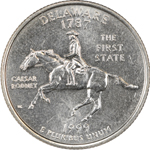
State and Territory Quarters
State & Territory Quarters
The State & Territory Quarters series represents one of the most ambitious and widely collected commemorative coin programs in American history. Launched in 1999, these iconic quarters captivated the nation with their rotating reverse designs that celebrated the unique heritage of each state and territory. Their accessible price point and educational value attracted millions of new collectors, young and old alike, to the hobby of numismatics.
Whether you're seeking to complete a date and mint mark collection, hunting for valuable errors, or appreciating the artistic storytelling across the series, State & Territory Quarters offer fascinating collecting opportunities for both beginners and advanced numismatists. With designs spanning from Delaware to American Samoa, these coins provide a numismatic tour of America's rich history and diverse landscapes.
Origin & History
The State Quarters Program emerged from a confluence of legislative interest and public enthusiasm for commemorative coinage. In 1997, Congress passed the 50 States Commemorative Coin Program Act, signed into law by President Bill Clinton on December 1 of that year. The legislation authorized a revolutionary 10-year initiative that would honor each of the 50 states on the reverse of Washington quarters, with five new designs released annually in the order that states ratified the Constitution or joined the Union. The program was designed not only to honor "the unique Federal Republic of 50 States that comprise the United States" but also to "promote the diffusion of knowledge among the youth of the United States" about American history and geography.
The ambitious program was championed by U.S. Mint Director Philip Diehl and Delaware Representative Mike Castle, who became key allies in bringing the concept to reality despite initial Treasury Department skepticism. The department's economic models conservatively estimated the program would generate between $2.6 billion and $5.1 billion in additional seigniorage (the difference between a coin's face value and production cost). By the program's conclusion, these projections proved accurate, with the Mint estimating earnings of approximately $3 billion in additional seigniorage and $136.2 million in numismatic profits.
The overwhelming success of the 50 State Quarters Program led to its extension with the 2009 District of Columbia and U.S. Territories Quarters Program, which honored Washington D.C. and five U.S. territories with their own commemorative quarters. This was followed in 2010 by the America the Beautiful Quarters Program, which continued the tradition through 2021 with designs featuring national parks and historic sites. Together, these initiatives transformed American pocket change into an educational canvas and created what the U.S. Mint has described as "the most successful numismatic program in U.S. history" with approximately 147 million Americans collecting the coins.
Design Elements
The State & Territory Quarters maintained John Flanagan's portrait of George Washington on the obverse, a classic design that has graced the quarter since 1932. However, to accommodate the commemorative reverse designs, several modifications were made to the obverse layout. The inscriptions previously found on the reverse -- "UNITED STATES OF AMERICA" and "QUARTER DOLLAR" -- were relocated to the obverse, along with "LIBERTY" and "IN GOD WE TRUST." This rearrangement created space on the reverse for the state and territory designs. Mint sculptor-engraver William Cousins was responsible for these modifications, ensuring visual balance while preserving the dignity of Washington's portrait.
The reverse designs represent the series' most distinctive feature, with each showcasing elements emblematic of a particular state or territory:
- 1999-2008 (50 State Quarters): Each reverse honored one of the 50 states in order of their ratification of the Constitution or admission to the Union. Designs were selected through a collaborative process involving state governors, citizens, and the U.S. Mint. They featured state symbols, landmarks, historical events, and natural wonders, with the state name and year of statehood or ratification appearing on each coin. The motto "E PLURIBUS UNUM" and the mint mark were also included on the reverse.
- 2009 (DC and U.S. Territories Quarters): Following the same format as the state quarters, these six designs honored the District of Columbia, Puerto Rico, Guam, American Samoa, the U.S. Virgin Islands, and the Northern Mariana Islands. The reverse of each quarter featured a design selected by the Mint depicting the federal district and each territory. Notably, the Puerto Rico quarter became the first U.S. coin to feature an inscription in Spanish with the motto "Isla del Encanto" (Island of Enchantment).
- 2010-2021 (America the Beautiful Quarters): Continuing the quarter redesign tradition, this program featured 56 designs showcasing national parks and historic sites from each state, territory, and the District of Columbia. Five designs were released annually for 11 years, with a final design in 2021.
All State & Territory Quarters were struck in the standard quarter specifications: 24.3mm diameter, 5.67g weight, with a composition of copper-nickel clad (8.33% nickel, balance copper) for circulation strikes. The U.S. Mint also produced silver proof versions containing 90% silver for collectors, adding another dimension to the series' collectibility.
Varieties & Key Dates
While State & Territory Quarters generally had high mintages, several valuable varieties and errors have emerged as prizes for attentive collectors. The 2004-D Wisconsin quarter with the "Extra Leaf" varieties stands as perhaps the most famous and sought-after in the series. Two distinct varieties exist: "High Leaf" and "Low Leaf," appearing as extra cornstalk leaves on the design. While some experts attribute these to die gouges from metal shavings, others have speculated they might have been deliberate modifications. Regardless of origin, these quarters can command prices from $50 to over $1,500 depending on condition.
The 1999 Delaware "Spitting Horse" variety represents another collector favorite, showing a raised die crack extending from the horse's mouth to the coin's rim. This fascinating variety still fetches $10 to $20 despite being more common than initially thought. Other notable state quarter varieties include the 2005-P Kansas quarter with the "IN GOD WE RUST" error (caused by grease filling the die), and the 2005-P Minnesota quarter with "Extra Tree" doubled die varieties.
Some 2000-P South Carolina quarters feature a striking error known as "Weak Reverse," where design elements appear faint or partially missing. The 1999-P Connecticut quarters with various die breaks and the 2009 District of Columbia quarters with doubled dies on "Ellington" also command premiums from variety hunters.
Beyond errors, collectors should be aware of several legitimate key issues in the series. The 2008-D Oklahoma quarter has the lowest mintage at just under 200 million, making it somewhat scarcer in circulation. The 2019-W and 2020-W America the Beautiful quarters, struck at West Point with tiny mintages of just 2 million per design, have become instant key dates and trade at significant premiums over face value.
For proof collectors, the silver proof quarters from the early years of the program are particularly desirable, with the 1999-S Silver Proof Set containing the first five state quarters being especially popular. The final years of the Territory quarters and America the Beautiful quarters series also saw relatively low silver proof mintages, creating additional key dates for comprehensive collections.
Collecting Insights
Building a meaningful State & Territory Quarters collection begins with determining your collecting strategy. The most straightforward approach is assembling a complete date-and-mint-mark collection of circulation strikes from Philadelphia and Denver. This can be accomplished relatively inexpensively through searching pocket change, purchasing rolls from banks, or acquiring complete sets from trusted dealers like L&C Coins.
For more advanced collectors, consider these specialized collecting approaches:
Condition is key - Even for modern coins, grade matters significantly. Newly minted state quarters should display full mint luster, sharp strike details, and minimal contact marks. Look for coins with strong strikes in the central design elements, as state quarter designs often suffered from weakness in high-relief areas. For circulated examples, try to acquire coins with minimal wear on the raised design elements.
Proof and silver options - Proof state quarters offer exceptional visual appeal with mirror-like fields and frosted devices. Consider collecting proof sets, silver proof sets, or individual proof quarters to appreciate the designs in their sharpest form. Silver state quarters provide both numismatic and precious metal value in one collectible package. Many collectors also pursue type coin collections that include examples from each major quarter series, including State quarters alongside Standing Liberty and Barber quarters.
Error and variety hunting - Searching for the valuable errors mentioned above can transform routine collecting into a treasure hunt. Arm yourself with a 5x to 10x magnifier and carefully examine each coin for doubled dies, die cracks, off-center strikes, and other anomalies. Remember that genuinely valuable errors are rare—while common striking defects might be interesting, they generally don't carry significant premiums.
Complete the journey - Many collectors who began with the 50 State Quarters expand to include the Territory quarters (2009) and the America the Beautiful series (2010-2021). This creates a comprehensive quarter collection spanning over two decades of American coinage history and featuring 111 different reverse designs. Some collectors also branch into other modern commemorative series like the Presidential dollars and Sacagawea dollars that were released during similar time periods.
When purchasing State & Territory Quarters, work with reputable dealers like L&C Coins who properly attribute varieties and grade according to ANA standards. Our numismatists have over 90 years of combined experience ensuring authenticity and proper grading. Explore our inventory of State & Territory Quarters today—all purchases include free shipping and our 15-day return privilege.
Frequently Asked Questions
Which State Quarters are the most valuable?
The most valuable State Quarters are those with significant errors or varieties. The 2004-D Wisconsin "Extra Leaf" High and Low varieties can sell for $50 to $1,500 depending on condition. Other valuable varieties include the 1999 Delaware "Spitting Horse," the 2005-P Kansas "IN GOD WE RUST," and the 2005-P Minnesota "Extra Tree" doubled dies. For non-error coins, the 2008-D Oklahoma quarter had the lowest mintage of the series. Proof versions and silver proof quarters generally command higher premiums than their circulation counterparts, especially for the earliest years of the program.
How can I tell if my State Quarter is a valuable error coin?
Examine your quarters with a magnifying glass (5x to 10x power), looking for unusual features like extra elements, doubled lettering, or die cracks. For the Wisconsin "Extra Leaf" varieties, look for an additional line resembling a leaf near the ear of corn. For the Delaware "Spitting Horse," look for a raised line extending from the horse's mouth. Kansas quarters may show "RUST" instead of "TRUST" due to a filled die. Be cautious about misidentifying normal die wear or post-mint damage as valuable errors. If you believe you've found a significant error, consider having it authenticated by a professional grading service or consult with our experts at L&C Coins.
Were all State Quarters minted at the same locations?
Regular circulation State & Territory Quarters were primarily minted at two facilities: Philadelphia (no mint mark or "P") and Denver ("D"). Proof versions were struck at the San Francisco Mint ("S"). Beginning in 2019, a limited number of America the Beautiful quarters were also struck at the West Point Mint ("W") and released into circulation as part of a promotion to spark interest in coin collecting. These "W" mint mark quarters are particularly scarce, with only 2 million produced for each design, making them highly sought after by collectors.
How much is a complete set of State Quarters worth?
A complete set of circulated 50 State Quarters (100 coins including both Philadelphia and Denver issues) typically sells for $25-$50, essentially their face value of $25 plus a small premium. Uncirculated sets in mint condition may sell for $50-$150 depending on quality. Proof sets command higher prices, with a complete set of copper-nickel proof quarters worth $125-$200, while silver proof sets can fetch $350-$600. Sets including the Territory quarters and America the Beautiful series would be proportionally more valuable. Individual coins with errors or in exceptional condition can significantly increase a set's value.
Did the State Quarters program really change American coin collecting?
Absolutely. The State Quarters Program revitalized coin collecting in the United States, introducing millions of new people to numismatics. The U.S. Mint estimated that approximately 147 million Americans collected State Quarters, making it the most popular coin collecting program in U.S. history. The program's success led to subsequent quarter redesign programs and inspired similar initiatives for other denominations, including the Presidential $1 Coins and Native American $1 Coins. The educational aspects of the program also fulfilled its congressional mandate to promote knowledge of American history and geography among young people.
What happened to the quarter design after the State Quarters Program ended?
Following the 50 State Quarters Program (1999-2008), the quarter design continued to evolve through two additional programs. First came the 2009 District of Columbia and U.S. Territories Quarters, which featured six designs honoring Washington D.C. and five U.S. territories. This was followed by the America the Beautiful Quarters Program (2010-2021), featuring 56 designs depicting national parks and historic sites from each state, territory, and the District of Columbia. In 2022, the American Women Quarters Program began, honoring notable American women with new reverse designs, scheduled to continue through 2025.
Are State Quarters still being made today?
The original 50 State Quarters Program concluded in 2008, followed by the Territory quarters in 2009 and the America the Beautiful series in 2021. While these specific designs are no longer being produced, the U.S. Mint continues to issue commemorative quarter programs. Currently, the American Women Quarters Program (2022-2025) features designs honoring notable American women who have made significant contributions to various fields. After 2025, new commemorative quarter programs may be introduced, continuing the tradition of using America's coinage to celebrate its history and culture.
Discover Quality, History-Rich Coins at L&C Coins
L&C Coins is a family-owned and operated business founded by coin enthusiast Lee Crane. Since 1974, we've offered our loyal customers a diverse selection of authentic and rare coins at a variety of price points to suit collectors of all levels.
In addition to a history-rich collection of both certified and uncertified coins, you'll enjoy free shipping with every standard order and free express shipping for orders of $25 or more. Should you have any questions, don't hesitate to contact our team of experts — we're here to help.