
Washington Quarters
Washington Quarters
The Washington Quarter, America's enduring 25-cent piece, has been a cornerstone of U.S. coinage since 1932, offering nearly a century of collecting opportunities. Originally created to commemorate the 200th anniversary of George Washington's birth, this iconic coin has evolved from a 90% silver composition to clad production, while maintaining John Flanagan's dignified portrait of our first president.
With multiple design series including the original eagle reverse, the revolutionary State Quarters Program, and the America the Beautiful quarters, Washington Quarters provide both beginning and advanced collectors a fascinating numismatic journey through American history. From scarce early issues like the 1932-D and 1932-S to modern varieties, these quarters combine accessibility, historical significance, and investment potential that few other coin series can match.
Origin & History
The Washington Quarter was born from the Treasury Department's decision to honor George Washington's 200th birthday in 1932. Initially intended as a commemorative half dollar, the plans changed when Congress proposed replacing the Standing Liberty Quarter instead. The Commission of Fine Arts held a design competition, ultimately selecting sculptor Laura Gardin Fraser's work. However, Treasury Secretary Andrew Mellon controversially overruled this selection, choosing John Flanagan's design instead—a decision that generated considerable debate in the numismatic community.
Production began in 1932 at the Philadelphia, Denver, and San Francisco Mints, with the latter two facilities producing limited quantities that created the series' key dates. The coins were originally struck in 90% silver and 10% copper, continuing in this composition until 1964, when rising silver prices forced a change to copper-nickel clad.
Throughout the decades, the Washington Quarter maintained remarkable consistency in its obverse design while experiencing several significant reverse changes. In 1975-1976, a special Bicentennial reverse by Jack Ahr temporarily replaced the eagle design, featuring a colonial drummer. The series underwent its most dramatic evolution beginning in 1999 with the launch of the 50 State Quarters Program, followed by the District of Columbia and U.S. Territories quarters in 2009, and the America the Beautiful Quarters Program from 2010 through 2021. Most recently, the 2022 American Women Quarters Program began highlighting achievements of notable American women on the reverse.
Design Elements
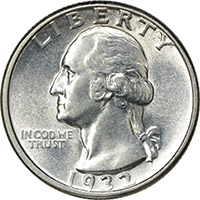
The obverse of the Washington Quarter features a left-facing profile portrait of George Washington based on Jean-Antoine Houdon's 1786 bust. Flanagan's adaptation presents Washington with a dignified expression, his hair tied in a ponytail. The inscriptions "LIBERTY" appear above the portrait, with the motto "IN GOD WE TRUST" to the left and the date positioned below. Mint marks, when present, are located on the right side behind Washington's hair tie (before 1968) or on the obverse right of the ribbon after 1968. The design conveys classical inspiration while honoring America's founding father with respectful portraiture.
The reverse design has undergone several significant evolutions throughout the series:
- 1932-1998: The original reverse featured a heraldic eagle with wings spread, clutching arrows and an olive branch, with "UNITED STATES OF AMERICA" above, "E PLURIBUS UNUM" below the eagle, and "QUARTER DOLLAR" at the bottom. This classic design remained largely unchanged for over 65 years.
- 1975-1976: A special Bicentennial design replaced the eagle with a Revolutionary War drummer boy, "200 YEARS OF FREEDOM" encircling the top, and a victory torch surrounded by thirteen stars. Regular production resumed with the eagle reverse in 1977.
- 1999-2008: The 50 State Quarters Program featured unique reverse designs for each state in order of their admission to the Union, with five new quarters released each year. These designs showcased state symbols, landmarks, and historical elements.
- 2009: The District of Columbia and U.S. Territories quarters featured designs representing DC, Puerto Rico, Guam, American Samoa, the U.S. Virgin Islands, and the Northern Mariana Islands.
- 2010-2021: The America the Beautiful Quarters Program displayed designs featuring national parks and sites from each state and territory, releasing five designs annually.
- 2022-2025: The American Women Quarters Program highlights distinguished American women with unique reverse designs celebrating their contributions.
Washington Quarters measure 24.3mm in diameter and 1.75mm in thickness, weighing 6.25g (silver) or 5.67g (clad). Silver issues (1932-1964) can be identified by their silver color, distinct ring when dropped, and edge that shows no copper layer, while clad issues (1965-present) display a thin copper layer visible on the edge.
Varieties & Key Dates
Washington Quarter collectors pursue several notable key dates and varieties that elevate a collection from ordinary to exceptional. The undisputed kings of the series are the 1932-D and 1932-S quarters, with mintages of just 436,800 and 408,000 respectively. These low production figures were the result of Depression-era budget constraints and limited demand for new quarters during economic hardship. In high grades, these coins command substantial premiums, with mint state examples regularly selling for thousands of dollars.
Other important early date issues include the 1934 Doubled Die Obverse, the 1937 Doubled Die Obverse, and the 1950-D/S overdate—all varieties that command significant premiums when properly attributed. The 1936-D is considered the third scarcest regular issue, particularly challenging to find with full head details, while the 1940-S often displays weak striking on the central design elements.
In the silver series, collectors also prize the 1942-D, notable for its strong strike and luster, and the 1943-S, which can be found with a spectacular doubled die obverse. The final year of silver production, 1964, saw billions of quarters hoarded by the public anticipating the composition change, yet well-struck examples remain surprisingly elusive.
Among the copper-nickel clad issues, the 1982-P and 1983-P stand out as particularly scarce in uncirculated condition—the result of few collectors saving rolls during those years. Additionally, the 1982-P and 1983-P quarters were only included in mint sets, not being distributed for circulation. Modern errors and varieties like the 2004-D Wisconsin "Extra Leaf" quarters continue to generate collector interest and command premiums.
For State Quarter enthusiasts, condition rarities include the 2005-P Minnesota quarter with a "Doubled-Die Extra Tree" variety and the 2009 District of Columbia quarter with a doubled die reverse. These modern varieties demonstrate that even recent issues can hold significant collector value when showcasing notable die variations.
Collectors pursuing higher-grade Washington Quarters should be particularly attentive to strike quality, especially on early silver issues where weak striking on Washington's hair details or the eagle's central features is common.
Collecting Insights
Building a distinguished Washington Quarter collection requires understanding the nuances that distinguish average examples from exceptional ones. Strike quality varies significantly throughout the series, with particular attention needed on Washington's hair details—especially the area above the ear which typically shows the first signs of wear. On early silver issues, collectors prize coins with "Full Head" details, where all hairlines and features are sharply defined.
Luster plays a crucial role in evaluating uncirculated Washington Quarters. Original mint luster should appear unbroken across the coin's surface, with silver issues displaying a cartwheel effect when rotated under light. Toning can either enhance or detract from a coin's appeal—natural toning in rainbow hues or deep silver-blue tones is highly desirable, while spotty or uneven toning may indicate cleaning or improper storage.
For collectors on a budget, consider focusing on a specific subset of the series. A silver Washington Quarter collection (1932-1964) provides both numismatic interest and intrinsic silver value. Alternatively, assembling complete sets of the State Quarters or America the Beautiful quarters offers achievable challenges with lower financial barriers to entry. More ambitious collectors might pursue a complete date-and-mint collection, adding key varieties as opportunities arise.
Many collectors also pursue type coin collections that include Washington Quarters alongside other classic American designs like Morgan dollars and Lincoln cents. When purchasing key dates like the 1932-D and 1932-S, authentication becomes paramount. These valuable coins have frequently been counterfeited or had mint marks added to common Philadelphia issues. Browse our extensive inventory of Washington Quarters in various grades to match your collecting goals and budget. All purchases include free shipping and our 15-day return privilege, giving you confidence in building your collection.
Frequently Asked Questions
What makes the 1932-D and 1932-S Washington quarters so valuable?
The 1932-D and 1932-S Washington quarters derive their value from their extremely low mintages—436,800 and 408,000 respectively—the lowest in the series. These limited production figures resulted from Depression-era budget constraints and reduced demand for circulation coinage. Additionally, as first-year issues, few were saved by collectors at the time. Their status as the key dates in this popular long-running series drives strong demand across all grade levels, with well-preserved examples commanding premium prices.
How can I tell if my Washington quarter is silver or clad?
Silver Washington quarters (1932-1964) can be distinguished from clad quarters (1965-present) through several methods. First, check the date—quarters dated 1964 and earlier are silver, while those from 1965 onward are typically clad. Second, examine the edge—silver quarters show a solid silver edge, while clad quarters display a distinctive copper sandwich layer. Third, silver quarters weigh approximately 6.25 grams compared to clad quarters at 5.67 grams. Finally, silver quarters produce a distinctive ring when dropped on a hard surface, unlike the duller sound of clad pieces.
What are the most valuable Washington quarter errors?
The most valuable Washington quarter errors include the 1937 Doubled Die Obverse, the 1950-D/S overdate where a D mint mark was punched over an S, and the 1943-S Doubled Die Obverse. In modern issues, the 2004-D Wisconsin State Quarter with "Extra Leaf" varieties (both High Leaf and Low Leaf) command significant premiums. Other valuable errors include off-center strikes, wrong planchet errors (particularly quarters struck on dime planchets), and major die breaks or "cuds." Generally, the more dramatic and visible the error, the greater its value to collectors.
Are Washington quarters worth collecting for investment purposes?
Washington quarters offer both collecting enjoyment and potential investment merit, particularly for key dates and high-grade examples. The 1932-D and 1932-S have consistently appreciated over time, especially in uncirculated conditions. Silver issues (1932-1964) provide intrinsic precious metal value that establishes a price floor. However, as with all collectibles, condition is paramount—coins in pristine mint state with strong eye appeal have historically shown the strongest appreciation. For the most rewarding experience, collect what you enjoy while focusing on quality, letting potential value appreciation be a secondary consideration.
What is the difference between Full Head and regular strike Washington quarters?
"Full Head" (FH) is a designation used primarily by PCGS to indicate Washington quarters with complete detail in the hair and wig tie on Washington's portrait. These areas, particularly above Washington's ear and at the ribbon of his wig, often show weakness even on uncirculated coins due to striking issues. Full Head quarters display sharp, complete detail in these typically weak areas, making them particularly desirable to collectors. The designation adds significant premium value to many dates, especially those from the 1930s and early 1940s known for striking difficulties, like the 1934-D and 1936-D.
How do I store my Washington quarter collection properly?
Washington quarters should be stored in archival-quality holders that are free from harmful chemicals like PVC, which can damage coin surfaces over time. For circulated coins, folders or albums designed specifically for Washington quarters provide convenient organization. For better coins, consider inert flips, capsules, or certified holders from professional grading services. Keep your collection in a cool, dry environment away from extreme temperature fluctuations, humidity, and air pollutants. Never clean your coins, as this significantly reduces their collector value. For silver issues, avoid materials that might cause tarnishing or spotting.
Discover Quality, History-Rich Coins at L&C Coins
L&C Coins is a family-owned and operated business founded by coin enthusiast Lee Crane. Since 1974, we've offered our loyal customers a diverse selection of authentic and rare coins at a variety of price points to suit collectors of all levels.
In addition to a history-rich collection of both certified and uncertified coins, you'll enjoy free shipping with every standard order and free express shipping for orders of $25 or more. Should you have any questions, don't hesitate to contact our team of experts — we're here to help.