Cherrypicking the Kennedy Half Dollar: A Guide to the Most Valuable Doubled Dies and "No FG" Varieties

The Specialist’s Target: Major Varieties and Minting Errors in the Kennedy Half Dollar
Section I: The Die Polishing Phenomenon: The "No FG" Varieties
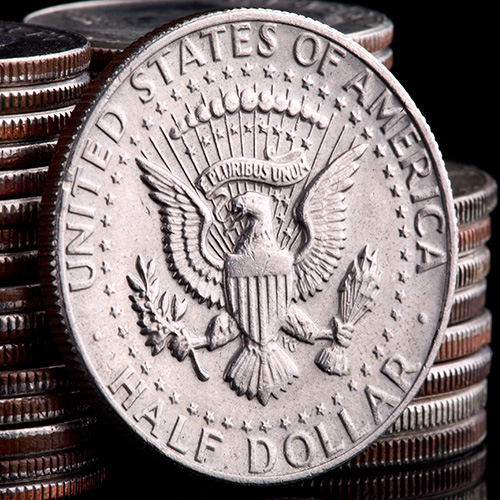
One of the most valuable and actively searched error types in the Kennedy series involves the initials of the coin’s reverse designer, Frank Gasparro. His initials, "FG," are typically located on the reverse, near the eagle’s left leg and the central tail feathers.
The "No FG" variety occurs when Mint employees, in an effort to prolong the life of the die by removing marks or imperfections, became over-zealous in their polishing. This aggressive abrasion inadvertently wiped the tiny initials completely off the surface of the die, resulting in coins that show absolutely no trace of "FG" where they should be.
The Clad Era Rarities (1971–Present)
The “No FG” errors are most famous and valuable within the copper-nickel clad era (1971–present) because base metal coins rely entirely on numismatic value, not bullion value.
1. The 1972-D No FG (Denver)
The 1972-D No FG is the rarest and most renowned of the circulating "No FG" errors. Discovered years after its production, this variety is relatively scarce.
Value Proposition: Due to its recognized scarcity, the 1972-D No FG commands a substantial premium. Even a nice circulated example (AU grade) can fetch around $400+, while Mint-State (uncirculated) coins typically realize $600 to $1000.
Identification Note: True "No FG" specimens often show visible die polish lines where the initials should have been. For verification, serious collectors often submit these coins for authentication, as a third-party grading slab ensures that the coin is a genuine variety and not one where the initials were manually removed.
2. The 1982-P No FG (Philadelphia)
The 1982-P No FG is a different instance of the same polishing error. Although more common than the 1972-D issue, it is still highly sought after.
Value Proposition: This variety holds strong premiums, especially in high grades. While an uncirculated example might bring around $40, the value accelerates rapidly for Gem condition. Examples graded MS-67 have been valued between $2,500 and $2,820.
The Silver-Clad Outlier (1966 SMS No FG)
Although not widely recognized as a major circulation error, the "No FG" phenomenon also occurred during the Special Mint Set (SMS) era (1965–1967). A few 1966 SMS halves are known to exist with missing "FG" initials. Since SMS coins were not released for circulation, these represent a specialized variety for set collectors.
Section II: Doubled Die Varieties (DDO/DDR)
Doubled die coins result from a mechanical misalignment that occurs when the die is impressed with the design hub, leading to overlapping or doubled features on the final coin. The Kennedy Half Dollar series includes several notable Doubled Die Obverses (DDO) and Doubled Die Reverses (DDR).
1. The Accessible Doubled Die: 1974-D DDO
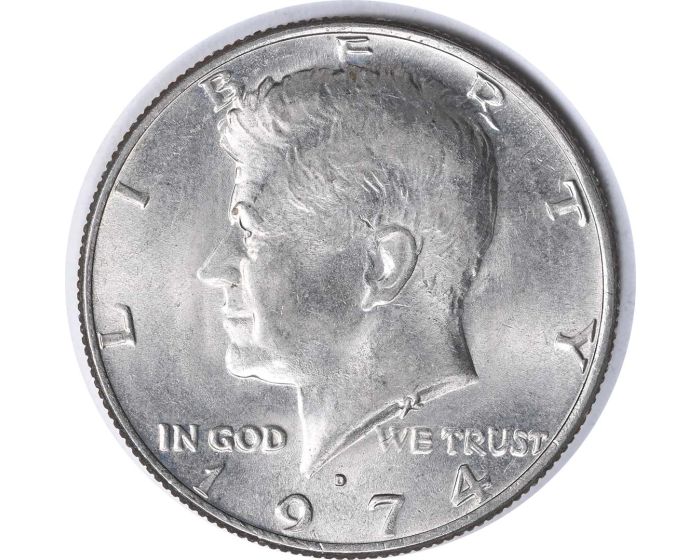
The 1974-D Doubled Die Obverse (DDO) is arguably the most dramatic and accessible doubled die in the clad series.
Identification: The doubling is most prominent and sometimes visible even without high magnification on the obverse motto “IN GOD WE TRUST,” particularly on the letters R, U, and S. Doubling may also be apparent on “LIBERTY” and the “4” in the date.
Collectability and Value: This is a major variety that is documented in standard numismatic references (like the Red Book). It is one of the varieties that can be "cherrypicked" from Mint Sets. Values are modest compared to the "No FG" errors but reliable, typically ranging from $10 in Very Fine (VF) up to $30 in Uncirculated condition.
2. The First-Year Doubled Dies (1964)
The high-mintage inaugural year also produced distinct doubled dies. These are 90% silver coins, meaning they always have the floor value of their silver content, but the variety adds a premium.
-
1964 Doubled Die Obverse (DDO): Shows noticeable doubling on the obverse lettering, particularly in the motto “IN GOD WE TRUST”.
-
1964 Doubled Die Reverse (DDR): Exhibits doubling on the reverse letters and is considered rarer than the DDO.
-
Value: These first-year varieties trade roughly from $30–$60 in mid-grade up to $150+ in Uncirculated condition for the scarcer DDR.
Section III: Proof Varieties: The 1964 Accented Hair
Among proof strikes, which are coins specifically made for collectors using polished dies and planchets, the 1964 Proof Accented Hair stands as a key collectible variety due to its historical origin.
Historical Significance and Design Change
In the early weeks of 1964 proof set production, an estimated 50,000 to 100,000 proof halves were struck with the initial design. The design featured more sharply defined hair strands above President Kennedy’s ear, a feature that was later modified after receiving feedback, reportedly from Jacqueline Kennedy, who preferred a softened look.
Key Diagnostics for the Accented Hair Proof
Since these coins represent only 2–5% of the total 1964 proof mintage, specialists rely on precise identification points:
-
Hair Detail: Look for pronounced, sharp, wire-like hair strands above the ear, often forming a V-shape.
-
Truncated Serif: The lower left serif of the letter “I” in “LIBERTY” is truncated or partially missing.
Value Driven by Grade
Because many Accented Hair proofs were saved, their rarity is largely conditional. While a typical example may sell for $40–$75, the true value lies in flawless condition with high contrast. An Accented Hair proof exhibiting Deep Cameo (DCAM) contrast and graded Proof-69 can command prices well over $1,000. One high-grade example (PR-69 DCAM) reportedly reached $46,800.
Section IV: Specialist and Type Varieties
Beyond mint errors and design variations, collectors also target special finishes and rare mint mark variations that require careful inspection.
The Lowest Mintage Non-Gold Coin: 1998-S Matte Proof
For the modern collector, the 1998-S Matte Proof is a critical variety due to its extremely limited production.
-
Mintage and Distribution: This coin has the distinction of being the lowest mintage non-gold Kennedy half dollar ever issued, with production figures estimated around 62,000–64,000 pieces. It was not available in standard proof sets but was sold exclusively in the two-coin Kennedy Collector’s Set commemorating Robert F. Kennedy.
-
Finish: This 90% silver coin is recognized by its unique matte finish—a uniform, non-reflective, satin surface that is distinct from the mirror-like finish of standard proofs.
-
Value: It is considered a key modern issue, valued around $80–$150 in typical proof condition, with high-end examples fetching much more.
Bicentennial and Proof Mint Mark Variations
Collectors targeting complete sets look for subtle differences in the Bicentennial issues and proof mint marks.
-
Bicentennial Types (1776–1976): All 1975- and 1976-dated half dollars carry the special Bicentennial reverse featuring Independence Hall. These were produced in two styles: Type I (thick, blocky letters) and Type II (sharp, refined lettering with thinner strokes). While both types were produced in massive numbers and are generally inexpensive, collectors often seek both for completeness.
-
Type II Mint Marks: In 1979 and 1981, the San Francisco Mint used two different punches for the “S” mint mark on proof coins. The rarer Type II “S” is typically clearer and rounder, and these issues (like the 1979-S Type II and 1981-S Type II) carry a notable premium among proof collectors.
Section V: Ultra-Rarities: The Museum-Quality Prototypes
While most varieties are attainable, the series does include experimental pieces so rare that they are considered outliers, commanding auction records.
The 1964 SMS Special Strike is the ultimate expression of rarity in the standard metal composition.
-
Rarity: Only around 12–20 specimens of this 90% silver coin are known to exist. These are thought to be trial pieces or prototypes never officially released to the public, possibly created in conjunction with 1965–1967 SMS production.
-
Finish: They are distinguished by a satin-textured finish and a striking sharpness unlike standard business or proof strikes.
-
Value: These pieces are museum-quality, selling for five- to six-figure sums. One specimen sold for $47,000 in 2016, and top-graded examples have been valued theoretically up to $5.9 million.
Summary Table of Specialist Varieties and Errors
The table below summarizes the core error and variety targets for the Kennedy Half Dollar specialist, providing key diagnostics and value tiers.
Variety / Issue, Composition, Distinguishing Feature(s), Typical Value (Low → High Grade)
|
Variety / Issue |
Composition |
Distinguishing Feature(s) |
Typical Value (Low → High Grade) |
|
1964 Accented Hair Proof |
90% Silver |
Truncated serif on the "I" in LIBERTY; sharp hair detail |
$40–$75 (Typical) → $1,000+ (PF69 DCAM) |
|
1964 Doubled Die Reverse (DDR) |
90% Silver |
Doubling visible in the reverse lettering |
$60 (VF) → $150+ (UNC) |
|
1972-D No FG |
Clad (Cu-Ni) |
Missing "FG" designer initials on the reverse (rare instance) |
$250 (VF) → $600–$1000 (UNC) |
|
1974-D Doubled Die Obverse (DDO) |
Clad (Cu-Ni) |
Strong doubling in "IN GOD WE TRUST" (most visible clad DDO) |
$10 (VF) → $30 (UNC) |
|
1982-P No FG |
Clad (Cu-Ni) |
Missing "FG" designer initials (common instance) |
$8 (VF) → $40 (UNC) → $2,500+ (MS67) |
|
1998-S Matte Proof |
90% Silver |
Unique satin finish; lowest mintage non-gold Kennedy (~62k) |
$100–$150 (Typical) → $325–$475 (High Grade) |
|
1964 SMS Special Strike |
90% Silver |
Ultra-rare prototype; satin finish; extremely sharp strike |
$47,000 → up to $5.9 million (theoretical top grade) |
Specialist’s Tool Kit: Hunting for Varieties
Searching for varieties, particularly the subtle "No FG" errors or doubling, requires more than just naked eye inspection.
Magnification is Essential: Use a minimum of 5x–10x magnification (jeweler's loupe or USB digital microscope) to inspect the critical areas: the eagle's tail feathers for the "FG" initials and the lettering for doubling.
Never Clean: Cleaning a coin destroys its original luster and significantly reduces its numismatic value, regardless of whether it is a rare variety or a common date. Collectors and grading services prefer original, uncleaned surfaces.
Authentication: For any highly valuable variety, like the 1972-D No FG or the Accented Hair Proof in high grade, professional certification by a third-party grading service (PCGS or NGC) is necessary to verify authenticity and condition.
The specialized hunt for Kennedy varieties is akin to searching for hidden messages in a widely printed book: while millions of copies exist, only the precise few with the misplaced ink or corrected letter reveal the true rarity and command the greatest price.
About the Author