Peace Silver Dollars: A Collector’s Guide to the Coin That Ended an Era

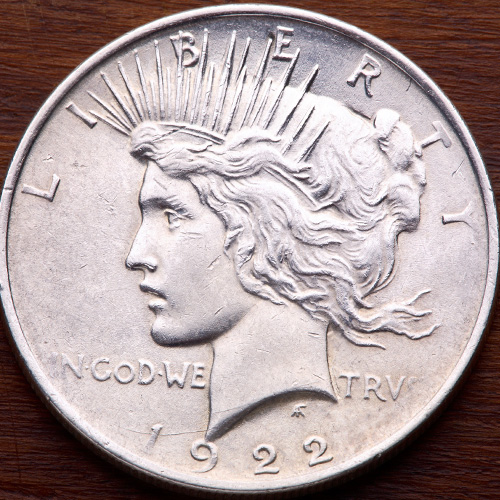
Every coin tells a story, but few tell it as directly as the Peace Silver Dollar. Created in 1921 to mark the end of World War I, the Peace Dollar carries its purpose in its name — the word "PEACE" inscribed boldly on the reverse, beneath a bald eagle at rest on a mountaintop. It is the only U.S. coin series designed from the outset as a statement of national intent, and that history gives it a resonance that purely monetary designs cannot match.
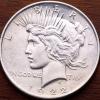
Anthony de Francisci won the design competition at just 34 years old, and his young wife Teresa served as the model for Liberty. The obverse shows Liberty in profile wearing a radiant crown with sunburst rays — a distinctly Art Deco interpretation that set the coin apart from the Victorian-era Morgan Dollar it replaced. The reverse features a bald eagle perched atop a mountaintop, clutching an olive branch, with rays of sunlight breaking behind. The original 1921 design included a broken sword beneath the eagle, but public outcry — many interpreted it as a symbol of defeat rather than peace — led to its removal before production began.
The 1921 High Relief: Where the Series Begins
The 1921 Peace Dollar holds a unique place in the series as both the first year of issue and the only year struck in high relief. The elevated design featured sharper, more pronounced details than any subsequent issue, but it proved difficult to produce at scale. Many 1921 coins show soft strikes despite the high-relief dies, because the pressure required to fully bring up the design exceeded what the Mint presses could consistently deliver.
Beginning in 1922, the Mint switched to a standard lower-relief design that was more practical for mass production. This makes the 1921 a one-year type coin — the only Peace Dollar with the high-relief format — and it is priced accordingly. With a mintage of just over one million coins (all struck in the final days of December 1921), the 1921 is one of the scarcer issues in the series across all grades.
Key Dates and Collecting Challenges
The Peace Dollar series was produced at three mints: Philadelphia (no mint mark), Denver (D), and San Francisco (S). Unlike the Morgan series, there are no Carson City issues. Production ran from 1921 through 1928, paused entirely from 1929 to 1933, and resumed for a final two-year run in 1934–1935.
The 1928 Philadelphia issue is the undisputed key date for the series. With a mintage of just 360,649 coins, it is by far the lowest-production business strike Peace Dollar. In high grades, 1928 Philadelphia coins command four-figure prices and serve as the gatekeeper for any serious complete set.
The 1934-S is the second-most-sought date, particularly in higher grades. While its mintage of just over one million sounds modest rather than rare, the coin is exceptionally scarce in MS65 and above because most examples saw heavy circulation or were weakly struck. San Francisco issues in general tend to have softer strikes than Philadelphia or Denver coins, making gem-quality S-mint Peace Dollars a consistent challenge for set builders.
Other dates that carry premiums include the 1921 (high relief, first year), 1927-D, 1927-S, and 1928-S. For new collectors, common dates like 1922, 1923, and 1925 in Philadelphia mint offer attractive coins at accessible prices, providing an excellent starting point for the series.
Grading and Certification
Peace Dollars present some unique grading considerations. The design’s high points — Liberty’s hair above the ear on the obverse and the eagle’s wing and leg feathers on the reverse — are the first areas to show wear, and they are also the areas most susceptible to weak strikes. This means that a softly struck MS65 can look remarkably similar to a lightly circulated AU58 to an untrained eye. Third-party grading from PCGS, NGC, or ANACS eliminates this ambiguity and provides confidence in both authenticity and grade.
Peace Dollars rarely develop the dramatic rainbow toning that Morgan Dollars are known for. The most common natural toning is a light golden or honey color. When multicolored toning does appear on a Peace Dollar, it commands significant premiums precisely because of its rarity in the series.
Building Your Peace Dollar Collection
The Peace Dollar’s greatest advantage for collectors is its completability. With only 24 major date-and-mint-mark combinations across its 14-year production span, a complete set is a realistic goal. Compare this to the Morgan Dollar’s 95+ varieties, and the Peace Dollar becomes the series where a collector can say "I finished it." That sense of accomplishment keeps collectors engaged and drives multiple purchases over time.
A practical approach is to start with the common Philadelphia dates (1922, 1923, 1924, 1925, 1926) in AU or low MS grades, then add the Denver and San Francisco mints for each year. Save the key dates — 1921 high relief, 1928, and 1934-S — for later, when your eye for quality is more developed and you can make those purchases with confidence.
For type collectors, a single high-quality example in MS64 or MS65 represents the series beautifully. Paired with a Morgan Dollar, a Seated Liberty Dollar, and a Trade Dollar, the Peace Dollar completes the classic silver dollar type set.
Explore our selection of certified Peace Silver Dollars at L&C Coins. With 50 years of experience and inventory spanning the full series from 1921 high relief through the final 1935 issues, we can help you find the right coin for your collection. Questions? Contact our team at 1-800-669-0953 — we are here to help.
About the Author