The Key Dates Kennedy Collectors Must Know: Finding the Lowest Mintage Half Dollars


Section I: The Restricted Mintages (Key Dates)
Unlike many older coin series, the Kennedy Half Dollar does not have a single “stopper” coin of extreme rarity in regular circulation strikes, making the series relatively accessible to complete.
However, specific dates are dramatically scarcer because they were either exclusively sold to collectors or produced in extremely low quantities.
1. The Key Date: 1970-D (Denver)
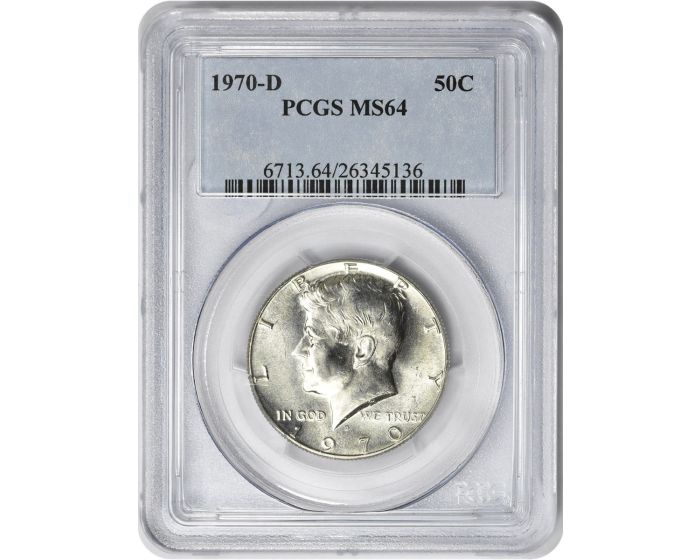
The 1970-D Kennedy Half Dollar is universally recognized as the lowest mintage business-strike half dollar in the entire series.
Scarcity and Distribution
Only 2.15 million 1970-D halves were struck at the Denver Mint. Critically, none of these coins were released into general circulation. They were produced solely for inclusion in the 1970 Mint Sets, which means that any 1970-D found in circulation today came from a collector who broke up a set and spent the coin. This unique distribution strategy makes the 1970-D the closest thing the series has to a true key date.
Value Considerations
The 1970-D is a 40% silver clad issue. While common examples can trade for around $8–$15 in typical uncirculated condition, the price rises sharply for high grades because the original Mint Set packaging often caused toning or spotting. Finding problem-free examples is challenging.
-
A typical Uncirculated 1970-D might be valued around $20.
-
However, high-end examples, particularly in grades like MS-67, are extremely rare and can reach $5,000–$7,500.
2. The Semi-Keys: 1987-P and 1987-D
Following declining demand, the Federal Reserve had a large existing supply of half dollars by the mid-1980s. Due to this surplus, the Mint suspended production of half dollars for general circulation entirely in 1987.
Similar to the 1970-D, the 1987-P and 1987-D Kennedy Half Dollars were struck only for inclusion in the 1987 Mint Sets. With mintages just under 3 million pieces each, they are considered semi-key dates for the clad series.
Although they are tougher to find in circulation than most 1970s and 1980s dates, their values are generally modest (often $1–$2 in uncirculated condition) because many sets were saved by collectors. Finding a 1987 half dollar in a roll of coins is still considered a significant find for a coin roll hunter.
3. The NIFC Era: 2002–2020 (The Modern Low-Mintage Set)
By 2002, the half dollar had largely ceased to appear in daily commerce. The U.S. Mint officially stopped releasing these coins to banks.
-
NIFC Definition: From 2002 through 2020, Kennedy half dollars were classified as “Not Intended For Circulation” (NIFC).
-
Mintage: Coins produced in this era were sold directly to collectors in rolls and bags at a premium above face value, resulting in relatively low mintages (typically between 1.7 million and 5 million pieces per mint).
Collectors actively seek these dates (2002–2020) to complete their sets, often acquiring them from dealers or successfully hunting them in bank rolls. While they usually carry small premiums (often under $2 each in Uncirculated condition), they represent a necessary, low-mintage sub-collection.
Section II: The Most Valuable Varieties and Errors
Some of the highest premiums in the Kennedy half dollar series come not from low mintages, but from valuable die varieties and errors created during the striking process. Collectors who specialize in these "cherrypicking" targets are often rewarded with significant value.
1. The "No FG" Varieties: Missing Designer Initials
One of the most highly sought-after errors involves the initials of the reverse designer, Frank Gasparro ("FG"), which normally appear near the eagle’s tail feathers.
The “No FG” variety occurs when Mint employees, in an effort to remove clash marks or die imperfections, over-polished the dies, completely erasing the initials. True "No FG" coins often show visible die polish lines where the initials should be.
1972-D “No FG”
The 1972-D No FG is the rarest and most famous instance of this error in the clad series. It is a recognized and scarce variety that can fetch hundreds of dollars.
Value: An excellent circulated example (AU grade) can reach $400+, while Mint-State examples can command $600–$1,000.
1982-P “No FG”
The 1982-P No FG is another widely collected instance of this variety. Though much more common than the 1972-D, it still carries a strong premium in high grades.
Value: While an average uncirculated coin might be worth around $40, a Gem condition example (MS65 and higher) can fetch up to $2,000 at auction.
2. Major Doubled Die Varieties
Doubled dies occur when the design impression is misaligned on the working die, causing overlapping, doubled lettering on the coin.
1974-D Doubled Die Obverse (DDO)
The 1974-D DDO is a particularly sought-after variety because the doubling is often strong and visible. The doubling is most evident on the motto “IN GOD WE TRUST,” particularly on the letters R, U, and S.
-
Collectability: This variety is listed in standard price guides like the Red Book. It is considered a major variety that is accessible for collectors to find ("cherrypick") in Mint Sets.
-
Value: Values are typically modest but reliable, ranging from about $10 in Very Fine (VF) up to $30 in Uncirculated condition, making it an excellent target for intermediate collectors.
1964 Doubled Die Varieties
The first year of issue also produced significant doubled dies. The 1964 Doubled Die Obverse (DDO) shows doubling on the obverse lettering (especially in “IN GOD WE TRUST”), and the 1964 Doubled Die Reverse (DDR) shows doubling on the reverse letters. The DDR is considered the rarer of the two.
Value: These varieties trade in the $30–$60 range in mid-grade, rising to $150+ in Uncirculated condition.
Section III: Proof and Special Collector Rarities
Some of the highest market values in the Kennedy series are reserved for specific proof strikes and special finishes, which are often conditional rarities (coins common in average grade but extremely rare in perfect grade).
1. The 1964 Proof "Accented Hair"
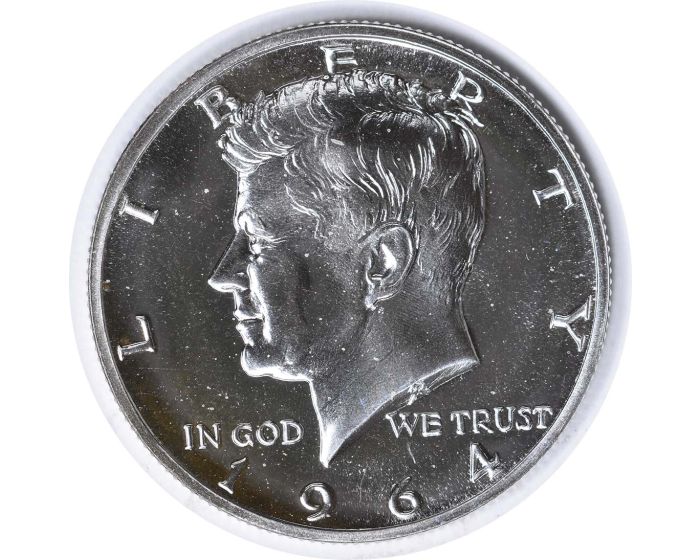
The 1964 Proof Accented Hair variety is one of the most historically important in the series. It represents the first design modification applied to the coin.
Origin and Identification
In the initial weeks of 1964 proof set production, an estimated 50,000–100,000 proof halves were struck before the design was modified. This initial design featured more sharply defined hair strands above Kennedy’s ear, reportedly softened later at the request of Jacqueline Kennedy.
Collectors identify this variety using key diagnostics:
-
Hair Detail: Enhanced, sharp, wire-like hair strands above the ear, forming a distinct V-shape or "W" shape.
-
Truncated Serif: The lower left serif of the letter “I” in “LIBERTY” is truncated or partially missing.
Value Dynamics
Although around 100,000 were struck (not tiny by variety standards), their price is highly dependent on condition.
-
A typical Accented Hair proof can cost $40–$75.
-
However, specimens exhibiting perfect surfaces and deep cameo contrast in grades like Proof-69 Deep Cameo (DCAM) are exceptionally rare and have reached values of $1,000 to over $46,800.
2. The Lowest Mintage: 1998-S Matte Proof
For modern collectors, the most challenging Kennedy half dollar to acquire for a complete set is the 1998-S Matte Proof.
-
Rarity: With a mintage of only approximately 62,000–64,000 pieces, this is the lowest production figure of any non-gold Kennedy half dollar issued.
-
Distribution: This coin was not found in the standard proof set but was issued exclusively as part of the two-coin Kennedy Collector’s Set commemorating Robert F. Kennedy.
-
Finish: This piece features a unique, uniform, non-reflective matte finish, which differs significantly from the deep mirror fields of standard proofs.
Due to its low mintage and unique finish, it is a key modern issue. Average proof examples are valued around $80–$150, with perfect grades (PF70) reaching considerably higher amounts.
Section IV: The Ultra-Rarities and Auction Records
While most collecting focuses on accessible key dates and varieties, the series has a few extreme outliers that command five- to six-figure prices, representing trial pieces or unique errors.
1964 Special Mint Set (SMS) Strikes
The 1964 SMS Special Strike is an ultra-rare experimental piece, likely a trial striking that was never formally released to the public.
-
Rarity: Only approximately 12 specimens of this 90% silver coin are known to exist.
-
Appearance: It is distinguished by a satin-textured finish and sharp strike, unlike the normal circulating or proof strikes of 1964.
-
Value: These pieces are museum-quality rarities. One specimen sold for $47,000 in 2016, and some top-graded examples are valued theoretically up to $5.9 million.
1964 Gold Experimental Strikes
The ultimate auction record for the denomination was set by a 1964 Kennedy half dollar struck in gold, an experimental piece never intended for release. Only a few of these 90% gold trial pieces are known. One pristine proof example sold for $5.8 million in 2025, demonstrating the historical importance and high-end demand for unique Kennedy artifacts.
Summary Checklist for Collectors
The primary driver of value in this series is the combination of rarity (low mintage) or variety (error) with high condition (grade). A flawed coin is often only worth its silver content (if applicable), but a top-grade variety can command a massive premium.
|
Date/Issue |
Rarity Type |
Key Feature to Check |
Approximate UNC Value Floor |
|
1970-D |
Low Mintage (Key Date) |
Issued only in 1970 Mint Sets (40% Silver) |
$20 (UNC) |
|
1972-D No FG |
Major Variety (Error) |
Missing "FG" initials near the eagle’s tail |
$600–$1,000 (UNC) |
|
1987-P & D |
Low Mintage (Semi-Key) |
Issued only in 1987 Mint Sets (Clad) |
$1–$2 (UNC) |
|
1964 Accented Hair |
Major Variety (Proof) |
Truncated “I” in LIBERTY; sharp hair lines |
$40–$75 (Typical Proof) |
|
1974-D DDO |
Major Variety (Error) |
Doubling visible in “IN GOD WE TRUST” |
$30 (UNC) |
About the Author