Mercury Dimes: A Collector’s Guide to Weinman’s Iconic Silver Ten-Cent Piece

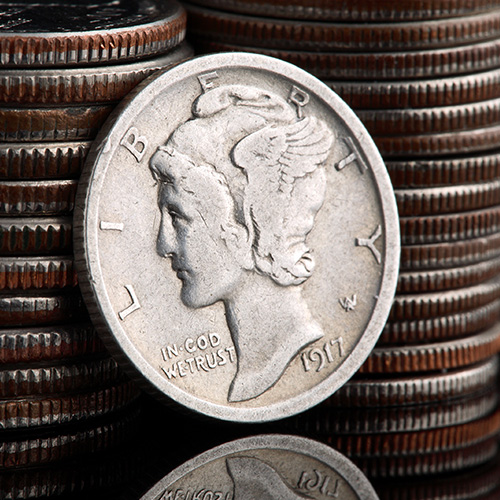
Few American coins pack as much artistry and collector appeal into such a small package as the Mercury Dime. Designed by Adolph A. Weinman and minted from 1916 through 1945, this 90% silver ten-cent piece is officially named the Winged Liberty Head Dime, though almost no one calls it that. The public saw the winged cap on Liberty’s head and thought of Mercury, the Roman messenger god, and the name stuck permanently.
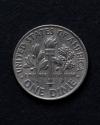
Weinman intended the wings to symbolize "liberty of thought," not to depict a Roman deity. The model for Liberty is widely believed to have been Elsie Stevens, wife of the poet Wallace Stevens, though Weinman never confirmed this publicly. Regardless of who posed, the result was extraordinary: a left-facing Liberty with flowing hair and a winged Phrygian cap, rendered with a level of detail remarkable for such a small canvas. The reverse features a fasces — a bundle of rods bound around an axe, the ancient Roman symbol of authority and strength — wrapped in an olive branch representing peace. The design debuted alongside Weinman’s other masterpiece, the Walking Liberty Half Dollar, and Hermon MacNeil’s Standing Liberty Quarter, making 1916 one of the most significant years in American coin design.
The 1916-D: The Key Date That Defines a Series
Every coin series has its key date, and for Mercury Dimes, it is the 1916-D. Only 264,000 were struck at the Denver Mint — by far the lowest mintage in the series. To put that in perspective, the Philadelphia Mint produced over 22 million Mercury Dimes that same year. The 1916-D has been a prized rarity since the 1930s, when collectors filling Whitman coin boards realized it was the one hole they could never find in pocket change.
Even in well-worn Good condition, a genuine 1916-D commands $650 to $800. In MS67 with Full Bands, the record price exceeded $200,000. Because of its value, the 1916-D is one of the most frequently counterfeited U.S. coins. Altered dates (turning a 1916 Philadelphia into a fake 1916-D by adding a mint mark) are common. For any 1916-D purchase, third-party certification from PCGS or NGC is not just recommended — it is a necessity.
Semi-Key Dates and Scarce Issues
Beyond the 1916-D, the series has two recognized semi-key dates: the 1921 and 1921-D. Both had low mintages (1.23 million and 1.08 million respectively) and were produced during a period of reduced coinage demand following World War I. Both dates are scarce in all grades and become genuinely rare in gem condition.
The 1926-S is another important issue. While its mintage of 1.52 million is not dramatically low, the coin is notorious for weak strikes and is exceptionally difficult to find in higher grades. Other dates that carry premiums include the 1919-D, 1919-S, 1924-D, 1925-D, and 1927-D. Two famous overdates — the 1942/1 (Philadelphia) and 1942/1-D (Denver) — are eagerly sought by variety collectors, with the Philadelphia issue being the more prominent and valuable of the two.
For new collectors, the series from 1934 through 1945 offers an excellent starting point. These later dates were produced in large quantities, are readily available in high grades, and provide the opportunity to assemble a partial set quickly while developing an eye for quality.
Full Bands: The Collector’s Premium
One of the most important distinctions in Mercury Dime collecting is the Full Bands (FB) or Full Split Bands designation. The horizontal bands that bind the fasces on the reverse are the highest point of the design and the first area to show a weak strike. When the bands are completely separated with a clear split between them, the coin earns the FB designation from grading services.
Full Bands coins command premiums that can range from modest (2x for common late dates) to extraordinary (10x or more for dates that are notoriously soft-struck). The 1918-S, 1919-S, 1926-S, and 1945 micro-S are among the dates where FB examples are particularly scarce and valuable. For the collector who wants a challenge beyond filling date-and-mint-mark holes, building a Full Bands set adds a layer of difficulty and reward that keeps the series engaging for years.
Grading and Authentication
Mercury Dimes are graded on the standard 1–70 scale. On the obverse, Liberty’s hair above the ear and the details of the winged cap show wear first. On the reverse, the bands on the fasces are the key diagnostic area. Third-party grading from PCGS, NGC, or ANACS provides confidence in both grade and authenticity, which is particularly important for key dates like the 1916-D, 1921, and 1921-D where counterfeits and altered coins exist.
Building Your Mercury Dime Collection
The Mercury Dime series spans 77 date-and-mint-mark combinations from 1916 through 1945 (excluding the 1932–1933 gap when no dimes were produced). A complete set is achievable for most collectors, though the 1916-D will be the biggest financial commitment. Many collectors build a complete set excluding the 1916-D, then add it as a capstone purchase. Others focus on assembling a Full Bands set of later dates, or collecting one example from each mint for each year.
Whatever your approach, Mercury Dimes offer a combination of affordability, artistic beauty, and collecting depth that few series can match. The small size makes storage easy, the silver content provides intrinsic value, and the history — spanning both World Wars and the Great Depression — connects collectors to some of the most consequential decades in American history.
Browse our selection of certified Mercury Dimes at L&C Coins. With 50 years of experience and inventory spanning the full series from 1916 through 1945, we can help you find the right coin for your collection. Questions? Contact our team at 1-800-669-0953 — we are here to help.
About the Author