Walking Liberty Half Dollars: Collecting the Design Behind the Silver Eagle

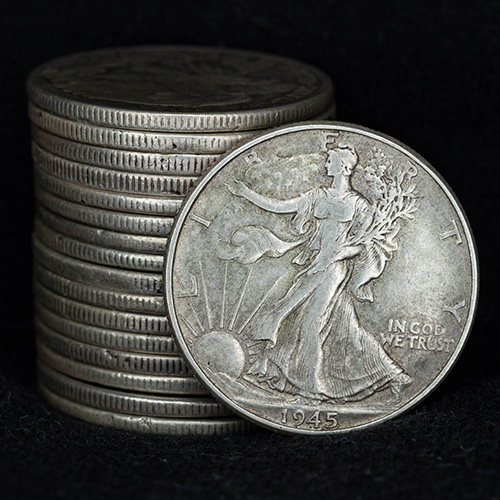
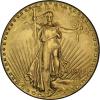
If you have ever held an American Silver Eagle, you already know Adolph Weinman’s Walking Liberty design. When the U.S. Mint launched its bullion program in 1986, they chose Weinman’s half dollar obverse from 1916 as the face of America’s flagship silver coin. That decision was not accidental. The Walking Liberty Half Dollar is consistently ranked among the most beautiful coins ever produced by any nation, and its image of Liberty striding toward the sunrise with the American flag flowing behind her has become one of the most recognized symbols in numismatics.
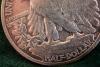
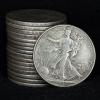
The original Walking Liberty Half Dollars were struck from 1916 through 1947 in 90% silver. At 30.6mm in diameter and containing 0.3617 troy ounces of pure silver, these are substantial coins with excellent hand feel and visual presence. The obverse shows Liberty in full stride, her right hand outstretched toward the dawn, her left arm cradling branches of laurel and oak symbolizing civil and military achievement. The reverse depicts a bald eagle perched on a rocky crag with a mountain pine growing from it, wings half-raised.
A Design Born From Competition
In 1916, the U.S. Mint replaced three denominations simultaneously: the dime, quarter, and half dollar. A design competition invited three sculptors to submit proposals. Weinman won commissions for both the dime (Mercury Dime) and the half dollar, an unprecedented achievement for a single artist. His Walking Liberty design drew from the French Beaux-Arts tradition he had studied under Augustus Saint-Gaudens, and art historian Cornelius Vermeule later called it "one of the greatest coins of the United States — if not of the world."
The design was not without production challenges. The detailed, high-relief elements proved difficult to strike consistently, and Chief Engraver Charles Barber — whose own designs were being replaced — was less than enthusiastic about helping perfect the new dies. Early strikes from 1916 and 1917 sometimes show the broader, more detailed borders that were eventually reduced for production efficiency. These early issues are prized by collectors for their superior detail.
Key Dates: The 1921 Trio
Following World War I, a surplus of coinage reduced demand for new production. The result was the three 1921 Walking Liberty Half Dollars, which together represent the pinnacle of the series’ rarity. The 1921-D had a mintage of just 208,000 coins — the lowest in the entire 32-year run. The 1921 Philadelphia (246,000) and 1921-S (548,000) round out the trio. Even in heavily worn condition, all three 1921 issues command significant premiums over common dates.
Other important dates include the first-year 1916 issues (particularly the 1916-S with its obverse mint mark), the 1917-D and 1917-S obverse mint mark varieties, the 1919-D and 1919-S, and the low-mintage 1938-D. For the collector building a complete set, these are the coins that require patience and a larger budget allocation.
The Mint Mark Migration
Walking Liberty Half Dollars have a unique mint mark story. In 1916 and early 1917, the mint mark for Denver and San Francisco coins appeared on the obverse, just below the motto "IN GOD WE TRUST." Partway through 1917, the mint mark was moved to the reverse, beneath the olive branch held by the eagle. This means that 1917-D and 1917-S coins exist in two varieties — obverse mint mark and reverse mint mark — both of which are collected separately. The obverse mint mark varieties tend to be scarcer and carry premiums over their reverse-mark counterparts.
Grading and What to Look For
Walking Liberty Half Dollars are graded on the standard 1–70 scale. The first areas to show wear on the obverse are Liberty’s head, her left hand, and the lines in the skirt at the hip and thigh. On the reverse, the eagle’s breast feathers wear first. Because of the complex, high-relief design, many Walking Liberties — even freshly minted ones — show areas of incomplete strike, particularly on Liberty’s hand and the eagle’s feathers. This is a strike characteristic, not wear, but it affects eye appeal and should factor into purchasing decisions.
Third-party certification from PCGS, NGC, or ANACS provides confidence in both authenticity and grade. For pre-1934 issues and key dates, certification is strongly recommended. Later dates (1934–1947) are more available in higher grades and can be found in attractive BU condition at reasonable prices.
Building Your Walking Liberty Collection
A complete set comprises 65 date-and-mint-mark combinations (including both obverse and reverse mint mark varieties for 1917). Unlike some classic series, there are no impossible rarities — every coin in the set exists in sufficient numbers to be acquired, though the 1921 trio will test both patience and budget.
A practical approach is to start with the later dates (1934–1947), which can be assembled in Fine to BU condition without significant premiums. Then work backward through the 1920s and 1930s branch-mint issues. Save the 1916 first-year issues and the 1921 trio for last, when your eye for quality is fully developed and you can make those key purchases with confidence.
For Silver Eagle collectors looking to connect with the original source, a single high-grade Walking Liberty Half Dollar in MS64 or MS65 makes a meaningful companion piece. Holding the original design next to its modern bullion descendant is a tangible connection to over a century of American coinage history.
Browse our selection of certified Walking Liberty Half Dollars at L&C Coins. With 50 years of experience and inventory spanning the full series from 1916 through 1947, we can help you find the right coin for your collection. Questions? Contact our team at 1-800-669-0953 — we are here to help.
About the Author