Franklin Half Dollars: The Brief American Series Worth Knowing

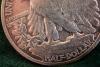
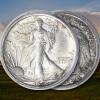
In 1948, the United States Mint replaced one of its most beloved coin designs—Adolph Weinman's Walking Liberty Half Dollar—with a new design honoring Benjamin Franklin. The decision was somewhat controversial. Replacing such a celebrated design seemed presumptuous, and the choice to honor a non-president on circulating coinage broke with longstanding tradition.
The Franklin Half Dollar series ran only 16 years before being replaced by the Kennedy Half Dollar in 1964 following President Kennedy's assassination. In that brief window, the Mint produced a complete series that today represents one of the most accessible 20th century silver sets and one of the most collected by registry specialists.
John R. Sinnock's Tribute to Franklin
John R. Sinnock served as Chief Engraver of the United States Mint from 1925 until his death in 1947. His best-known design before the Franklin Half was the Roosevelt Dime, introduced in 1946 following President Roosevelt's death. Sinnock's selection of Benjamin Franklin for the new half dollar reflected longstanding admiration—Sinnock had reportedly wanted to honor Franklin for years before the opportunity arose.
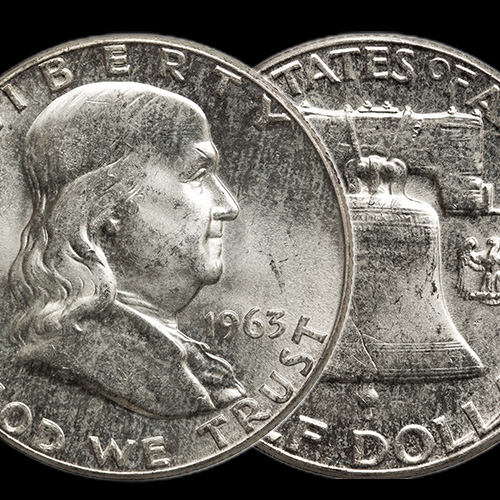
Sinnock died in May 1947, before the Franklin Half Dollar entered production. His assistant, Gilroy Roberts, completed the final design work. Sinnock's initials, JRS, appear on the obverse below Franklin's portrait—a touch that briefly fueled conspiracy theories during the early Cold War era when some claimed the initials referenced Joseph Stalin.
The obverse features a right-facing portrait of Franklin based on Jean-Antoine Houdon's 1778 marble bust. The reverse depicts the Liberty Bell, including its famous crack, modeled by sculptor John Frederick Lewis. A small eagle appears to the right of the bell—not part of Sinnock's original design, but added to comply with the Coinage Act of 1792, which required an eagle on all half dollar and larger silver coins.
A Brief but Complete Series
The Franklin Half Dollar was struck at three mints (Philadelphia, Denver, and San Francisco) from 1948 to 1963. Total production includes 35 distinct date and mint mark combinations across business strikes, plus 14 proof issues from Philadelphia between 1950 and 1963.
Compared to longer-running series, the Franklin offers collectors a manageable scope. A complete circulation strike date set is achievable in choice Mint State for budgets that would barely cover key dates in many other series. The proof set spans 14 dates and provides another collecting path entirely.
Full Bell Lines: The Registry Collector's Pursuit
The Full Bell Lines (FBL) designation defines registry-level Franklin Half Dollar collecting. The reverse design depicts the Liberty Bell with horizontal lines representing the bell's curvature. Both PCGS and NGC apply the FBL designation only to coins showing complete, unbroken bell lines—particularly the lower set of lines that are most affected by strike weakness and bag marks.
Strike quality varies significantly across the series. Philadelphia issues from the 1950s often show strong bell lines, while San Francisco coins from the early 1950s frequently received softer strikes. The 1953-S Franklin Half is famously elusive in FBL—high-grade examples are far scarcer than mintage figures suggest.
The pricing impact of FBL designation can be dramatic. A common-date Franklin Half in MS65 might trade for under $50, while the same coin with FBL designation could bring $200 or more. Tougher dates with FBL command substantially greater premiums. Top-grade examples in MS67 FBL are among the most challenging modern silver coins to acquire.
Key Dates and Notable Issues
1949-S
The lowest-mintage business strike in the series at 3.74 million. Tough in higher Mint State grades and particularly elusive in FBL.
1953
Philadelphia mintage of just 2.66 million—the lowest Philadelphia issue. Demand-driven scarcity in MS65 and finer.
1955
Philadelphia mintage of 2.88 million. Famous for the "Bugs Bunny" variety—a die clash with the eagle's wings that left Franklin appearing to have buck teeth. The variety is collected separately and brings premiums in attractive Mint State.
1953-S
Notorious for weak strikes. While the mintage of 4 million isn't particularly low, FBL examples are rare to the point of legendary status among Franklin specialists.
1956 Type 1 and Type 2 Proofs
Two distinct reverse hub varieties exist. The Type 2 reverse, with stronger eagle feather detail, is significantly scarcer in proof sets and commands premiums.
Cameo and Deep Cameo Proofs
Franklin proof coins exist with varying degrees of frosted contrast against the mirror fields. Coins with strong cameo contrast (CAM) bring premiums; coins with maximum contrast (Deep Cameo or DCAM) bring substantial premiums.
Earlier dates (1950-1955) typically show less cameo contrast due to die preparation methods of that era. Later proofs (1957-1963) more frequently exhibit strong cameo, but DCAM examples remain scarce across all dates and bring registry-level prices when in high grades.
Why Collectors Pursue Franklin Halves
Several factors drive sustained interest in the series:
Achievable scope: Complete circulation strike sets are realistic pursuits for committed collectors at modest budgets.
Condition challenges: FBL designation creates condition rarity even for high-mintage dates, providing pursuit for advanced collectors.
Silver content: Each coin contains 0.36169 troy oz of pure silver—meaningful tangible content that has supported pricing across market cycles.
Historical bridge: The series spans the postwar boom into the early 1960s, capturing a specific American era.
Building Your Franklin Half Dollar Collection
Most collectors approach the series through one of several pathways:
Type Coin
A single representative example. Common-date pieces in choice Mint State satisfy type set requirements.
Date Set
All 35 business strikes. Achievable in MS63-MS65 across modest budgets. Adding the proof issues completes the series at 49 coins total.
FBL Date Set
The advanced collector's pursuit. Significantly more challenging than the standard date set, with key dates becoming substantial obstacles.
Top Pop Pursuit
Registry collecting at the highest levels. MS67 FBL examples for tough dates can require years of patience to acquire.
Adding Franklin Halves to Your Collection
At L&C Coins, we offer certified Franklin Half Dollars graded by PCGS, NGC, ANACS, and CACG. Our typical inventory includes type coins for new collectors, date set fillers, FBL-designated examples, and proof issues across the date range.
Our family business has served collectors since 1974—50 years of experience helping numismatists find the right coins. Every piece carries our 100% authenticity guarantee and 15-day return privilege. Our layaway program ($100 minimum, 20% down, four interest-free payments) makes substantial pieces accessible.
A Series Worth Discovering
The Franklin Half Dollar may not have the longest production run or the most famous design in American numismatics, but it occupies a meaningful place in the collecting hierarchy. For new silver collectors, it offers achievable goals. For advanced collectors, it offers genuine condition challenges. For everyone, it offers a brief American classic worth discovering.
Browse our current selection of Franklin Half Dollars at L&C Coins. Questions about building your set? Call us at 1-800-669-0953—we're happy to help.
About the Author