Saint-Gaudens Double Eagle: The Story Behind America's Most Beautiful Coin

In 1904, Theodore Roosevelt sat down to write a letter that would change American numismatics forever.
Writing to his Treasury Secretary, the President called the state of U.S. coinage "atrociously hideous" and announced his intention to do something about it. He turned to America's foremost sculptor, Augustus Saint-Gaudens, with a remarkable request: redesign the nation's gold coinage in the manner of ancient Greek high-relief sculpture.
The result, struck from 1907 to 1933, became what numismatists almost universally agree is the most beautiful coin the United States has ever produced. The Saint-Gaudens Double Eagle—a $20 gold piece weighing nearly an ounce—elevated American coinage to the level of fine art.
Roosevelt's "Pet Crime"
Roosevelt's pursuit of beautiful coinage wasn't a passing fancy. He famously called it his "pet crime"—a deliberate move that bypassed standard Mint procedures and engraving department conventions. Roosevelt wanted American money to reflect the artistic ambition of the nation, and he was willing to circumvent bureaucracy to achieve it.
Augustus Saint-Gaudens was the obvious choice. Already celebrated for monumental works including the Robert Gould Shaw Memorial in Boston and the General Sherman statue in New York's Central Park, Saint-Gaudens brought sculptural sensibility to a medium dominated by engravers. He envisioned coins that would carry the dignity of ancient Greek tetradrachms—high relief, classical imagery, and artistic ambition.
Tragically, Saint-Gaudens never lived to see his work in circulation. He died in August 1907, just months before the first Double Eagles bearing his designs reached the public. The Mint's chief engraver, Charles Barber—who had reportedly resisted Saint-Gaudens's involvement throughout the process—oversaw the final modifications needed to make the design technically producible.
The High Relief 1907: A Numismatic Legend
The first Saint-Gaudens Double Eagles struck in 1907 featured an extraordinarily high relief that required multiple strikes per coin to bring up the design. Only about 12,367 examples of these MCMVII High Relief pieces were produced before the Mint conceded that the design was impractical for mass production.
These early High Relief coins also featured Roman numerals (MCMVII for 1907) rather than standard Arabic numerals—Saint-Gaudens's nod to classical antiquity. The combination of high relief, Roman numerals, and limited mintage makes the 1907 High Relief one of the most coveted U.S. gold coins in any collection.
By late 1907, the Mint had transitioned to a low-relief version with standard Arabic numerals. While less artistically ambitious than the original, these coins still carried the essential beauty of Saint-Gaudens's design and remained in production for the next 26 years.
Design Details: Lady Liberty Strides Forward
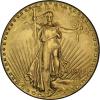
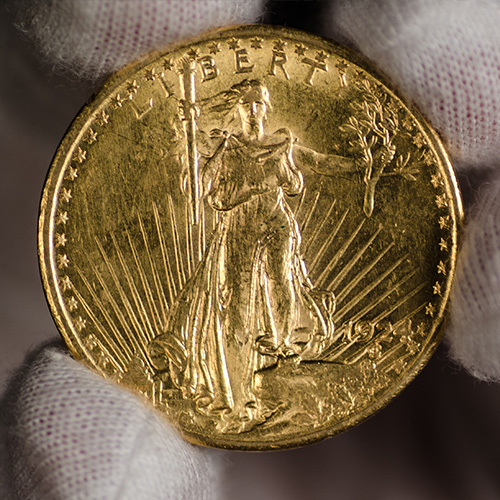
The obverse depicts Lady Liberty striding forward from a rocky outcrop, holding a torch in her right hand and an olive branch in her left. The Capitol building appears in the lower left, with the sun's rays radiating from behind. Saint-Gaudens drew inspiration from classical Victory figures, creating an image of optimistic American forward motion.
The reverse features a flying eagle above the rising sun, with rays extending outward. The composition is uniquely American—an eagle in motion rather than the static heraldic eagles common to earlier coinage.
One notable design controversy: Roosevelt insisted that "In God We Trust" be omitted from the original design, believing the use of God's name on money was vulgar. Public outcry led Congress to mandate the motto's inclusion in 1908. Saint-Gaudens Double Eagles struck without the motto (1907 and early 1908) command additional collector interest as distinct types.
Key Dates and Major Varieties
Building a Saint-Gaudens collection involves understanding several major distinctions:
1907 High Relief MCMVII
The series flagship. Roman numerals, exceptionally high relief, mintage of 12,367. Examples in any grade command significant premiums.
1907-1908 No Motto
Coins struck before the "In God We Trust" requirement. A required type for complete collections.
1908-S
Low mintage of just 22,000—the lowest of the With Motto type from San Francisco.
1909-D and 1909-S
Both branch mint issues are scarcer than their Philadelphia counterpart.
1920-S
A famous rarity. Only about 558,000 minted, but most were melted before release. Surviving examples in Mint State are particularly elusive.
1921
Among the rarest issues. Mintage of 528,500, but the great majority were melted.
1927-D
The legendary key date. Mintage of 180,000, but only about a dozen examples are known to exist today—nearly all were melted.
1933
The final year. Most of the 445,500 struck were never officially released and were melted following the 1933 gold recall. Possession of most 1933 Double Eagles remains illegal under federal law. The single legal example sold in 2002 for $7.6 million; another sold in 2021 for $18.9 million, setting the world record for any coin.
Grading and Certification
Saint-Gaudens Double Eagles are extensively certified by PCGS, NGC, and CAC Grading. Common-date examples in MS62 and MS63 are widely available, while MS65 and finer examples carry meaningful premiums. Star designations, plus grades (e.g., MS64+), and CAC stickers add further value distinctions.
For collectors building type sets, a single MS63 or MS64 example provides an attractive representative coin. For date set collectors, condition rarity creates pursuit—even common dates become scarce in MS66 and finer.
Why Collectors Pursue Saint-Gaudens
Several factors drive sustained collector demand for the series:
Artistic merit: The aesthetic case for Saint-Gaudens is universally recognized. Few collectors look at a Mint State example without admiring the design.
Historical significance: The series spans the early 20th century, ending with the gold recall that transformed American monetary policy.
Tangible gold: Each coin contains nearly a full ounce of gold (0.9675 troy oz), giving the series substantial intrinsic content alongside numismatic value.
Multiple collecting approaches: Type sets, date sets, mint mark sets, condition rarities, and specialized No Motto/With Motto pursuits give collectors many ways to engage with the series.
Adding Saint-Gaudens to Your Collection
At L&C Coins, we offer certified Saint-Gaudens Double Eagles graded by PCGS, NGC, ANACS, and CACG. Our inventory typically includes common dates in collector-grade Mint State, key dates when available, and selected high-grade examples for registry collectors.
Our family business has served collectors since 1974—50 years of experience helping numismatists acquire the coins that matter most to them. Every coin we sell carries our 100% authenticity guarantee and 15-day return privilege. Our layaway program ($100 minimum, 20% down with four interest-free payments) makes meaningful additions accessible across price points.
A Coin Worthy of Its Reputation
More than a century after the first MCMVII Double Eagle was struck, Saint-Gaudens's vision still defines what American coinage could be at its artistic best. Whether you're acquiring your first example or pursuing condition census coins for a registry set, the Saint-Gaudens Double Eagle remains one of the most rewarding series in American numismatics.
Browse our current selection of Saint-Gaudens Double Eagles and other classic U.S. gold at L&C Coins. Questions about building your gold collection? Call us at 1-800-669-0953—we're happy to help.
About the Author