Grading Kennedy Half Dollars: The Keys to Deep Cameo, Conditional Rarity, and Top Market Prices

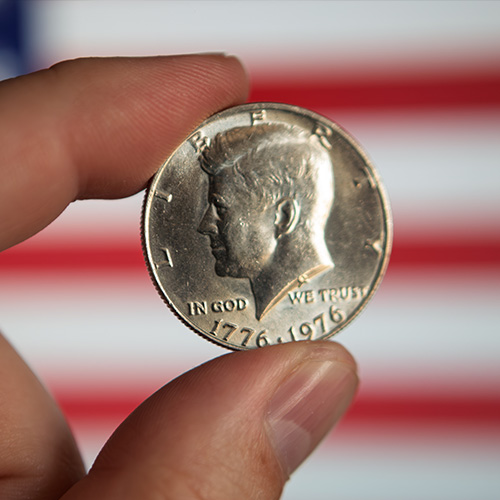
For most Kennedy Half Dollars, intrinsic metal value or low mintage provides a baseline price. However, what transforms an ordinary coin into a highly desirable numismatic piece is its condition and finish. In the collector market, scarcity is only half the story; a coin’s value is ultimately determined by its certified grade on the 70-point Sheldon scale.
Understanding how condition and special finishes affect pricing is essential for maximizing the perceived value of any Kennedy half dollar, turning a common date into a conditional rarity.
I. The Impact of Grade: Conditional Rarity
Rarity in coins is generally defined in two ways: scarcity by mintage (how few were made) and scarcity by condition (how few survived in perfect grade). For the Kennedy series, condition rarity drives the highest numismatic premiums.
The Sheldon Scale and Conditional Rarity
The value of a coin is classified using the 70-point Sheldon scale. Mint State (MS) grades range from MS-60 to MS-70 for uncirculated business strikes, while Proof (PR or PF) grades are reserved for special strikes made for collectors.
A coin is considered a conditional rarity if it is common in circulated condition but virtually flawless examples are extremely hard to find.
-
Circulated vs. Uncirculated Value: Most Kennedy halves issued after 1970 are copper-nickel clad and are generally worth face value (50¢) in circulated condition because they contain no precious metal.
-
The Grade Jump: The premium increases dramatically as the grade approaches perfection. For instance, a common clad half dollar from the 1970s, which is worth 50¢ in average condition, has been known to sell for thousands of dollars if it achieves a grade of MS-68 because such a flawless specimen is rarely encountered.
Key Date and Condition Synergy
Conditional rarity amplifies the scarcity of low-mintage key dates. The 1970-D half dollar, the lowest mintage business strike, demonstrates this perfectly.
-
In typical uncirculated (UNC) condition, the 1970-D is valued modestly (about $8–$20).
-
However, finding a problem-free example is challenging because the coin was only issued in 1970 Mint Sets, and the packaging often caused spotting or toning.
-
Therefore, examples that achieve top grades, such as MS-66 or MS-67, are extremely rare and command prices reaching several hundred dollars, or potentially $5,000–$7,500 for the finest MS-67 examples due to competition among registry set collectors.
II. The Premium Finishes: Proofs, Cameos, and Special Striking
For coins produced for collectors, the quality of the finish and the degree of contrast are the primary value drivers.
Deep Cameo (DCAM) Contrast
Proof coins are struck multiple times using specially polished planchets and dies, resulting in a mirror-like finish. The most desirable finish designations are based on the degree of contrast between the coin's design (devices) and the background field.
-
Cameo (CAM): Features moderate frosting on the device against a mirror field.
-
Deep Cameo (DCAM or UCAM): Features heavy, thick frosting on the device, creating a striking contrast against the highly reflective, liquid-mirror background.
For example, a standard 1971-S Proof might have a value of $2, but one with a Deep Cameo designation can be worth $20, demonstrating how the finish can multiply value. Scarcity drives premiums for DCAM proofs, especially those from the 1960s and 1970s, where only about one in twenty proofs may qualify for the DCAM designation because the dies lost their frosty quality quickly.
Case Study: The 1964 Accented Hair Proof
The 1964 Proof Accented Hair variety is one of the most famous conditional rarities in the proof sector. While an estimated 50,000–100,000 were struck, the value is highly dependent on perfect preservation and contrast.
-
A typical example of the variety might trade for $40–$75.
-
However, if the coin possesses spectacular contrast and flawless surfaces, achieving the grade of Proof-69 Deep Cameo (DCAM), it becomes highly sought after, with values that have reached over $1,000.
Special Finishes
Certain special issues, which are distinct types defined by their finish, also command strong premiums:
-
1998-S Matte Proof: This issue is prized not just for its low mintage (around 62,000 pieces), but for its unique, uniform, non-reflective matte finish. It was sold exclusively in the Robert F. Kennedy Collector’s Set. The distinctive frosted matte finish differs significantly from standard mirror-like proofs, and specimens trade for $80–$150 in typical proof condition and considerably more in perfect grades.
-
Special Mint Sets (SMS): The Kennedy halves issued in SMS sets (1965–1967) feature a distinct satin-like finish resulting from being struck on polished planchets using polished dies. Although these are generally common, those that exhibit rare Deep Cameo contrast (especially 1965 and 1967) are highly valued.
III. The Role of Authentication and Preservation
For high-value coins, the perceived value of the condition relies entirely on the authentication and assessment provided by third-party grading services like PCGS or NGC.
Grading for Authenticity and Condition
Certification confirms the coin’s grade and verifies the authenticity of rare varieties, preventing collectors from purchasing altered or misidentified pieces. For instance, a certified "No FG" error (where the designer initials were polished off) is distinguished from a coin where the initials were manually removed.
Critical Preservation Rules
Maintaining a coin’s original surface is paramount, as a collector market preference for original, uncleaned surfaces is nearly universal.
-
Never Clean: Cleaning a coin, even gently, destroys its original luster and permanently reduces its numismatic value.
-
The Milk Spot Plague: A serious condition issue affecting modern silver proofs (including the 1992-present 90% silver proofs) is the appearance of milk spots. These cloudy white blotches are caused by residue left on the planchets during minting. Milk spots are generally considered terminal damage by the market, meaning a coin that develops them effectively loses its grade and premium. Grading services will not assign a perfect "70" grade if these spots are present.
Full Strike Characteristics
A key aspect of a coin's quality grade is the fullness of the strike. Many early copper-nickel clad Kennedy halves (1971 through the mid-1980s) suffered from weak strikes. Graders look for evidence of a full strike to assign higher MS grades:
-
Obverse: Complete hair detail without weakness or fading.
-
Reverse: All eagle feathers fully separated and defined.
-
Motto/Date: Sharp lettering with no weakness or design elements fading into the fields.
Summary: Value Tiers Based on Grade and Finish
The following table illustrates how the numismatic value of a Kennedy Half Dollar transcends its base melt or face value when specific grade and finish criteria are met.
|
Coin Type / Issue |
Grade (MS/PF) |
Value Driver(s) |
Typical Estimated Value Range |
|
Common Clad (1971–90) |
MS-68 |
Conditional Rarity (Flawless surfaces) |
$500 – $1,000+ |
|
1970-D Key Date |
MS-66 to MS-67 |
Low Mintage + Conditional Rarity |
$150 – $300 |
|
1964 Silver |
MS-67 to MS-68 |
High-Grade Survivor (90% Silver) |
$50 – $100 (MS66) → $2,500+ (MS68) |
|
1964 Accented Hair |
PF-69 DCAM |
Variety + Deep Cameo Contrast |
Up to $46,800 (record for PR-69 DCAM) |
|
1982-P No FG |
MS-67 |
Variety + Top Condition |
Up to $2,500 – $2,820 |
|
1998-S Matte Proof |
SP-68/69 |
Lowest Mintage (Special Finish) |
$125 – $300+ |
Understanding the value drivers of condition and finish is like recognizing that a diamond’s price is not just based on its weight, but primarily on its cut, clarity, and color. For the Kennedy Half Dollar, the difference between a $5 silver coin and a conditional rarity worth thousands lies in the microscopic details of its strike and the quality of its preservation.
About the Author