How to Collect Walking Liberty Half Dollars: Short Set, Key Dates, and Gems

Most collectors meet the Walking Liberty Half Dollar twice. The first time is on the American Silver Eagle, which has carried Adolph A. Weinman's design since 1986. The second time is when they learn the design is seventy years older than that, and that the original half dollars, struck from 1916 to 1947, are sitting in dealer inventories waiting to be collected. This guide is for that second meeting. There are three well-worn paths into the series, and most collectors end up walking all of them.
Why collectors start here
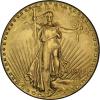
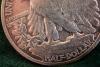
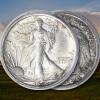
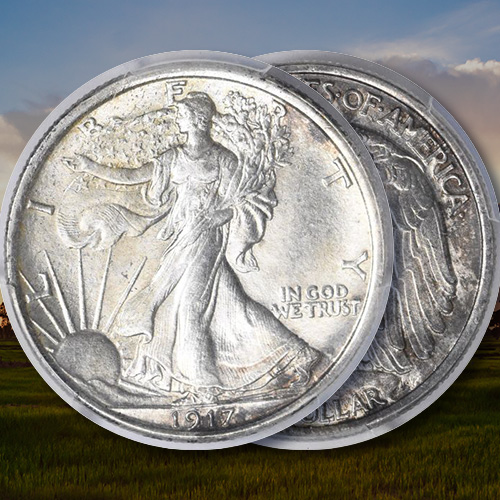
Weinman designed the coin in 1916, the same year his Mercury Dime debuted, and it replaced Charles E. Barber's half dollar after twenty-four years. Liberty strides toward the sunrise in a flowing gown draped with the flag, an arm outstretched and branches of laurel and oak in the other. The reverse eagle perches on a mountain crag beside a pine sapling, wings half open. Collectors have called it the most beautiful American coin design for a century, and the Mint agreed when it chose the obverse for the Silver Eagle.
The series ran thirty-two years across three mints: Philadelphia (no mint mark), Denver (D), and San Francisco (S). It is 90 percent silver, 30.6 millimeters across, and heavy enough in the hand to feel like money. There are 65 date-and-mint combinations, no impossible rarities, and a handful of dates hard enough to keep the chase honest. That balance is why it is one of the most collected classic series in American numismatics.
Path one: the short set
The short set is the classic starting point, and it exists because of the way the series ended. From 1941 through 1947, all three mints struck Walking Liberty halves in large quantities, and the coins went straight into a country that was saving everything. The result is twenty coins with no key dates, all available in Mint State, that assemble into a complete and satisfying run.
|
Year |
Mints |
|---|---|
|
1941 |
P, D, S |
|
1942 |
P, D, S |
|
1943 |
P, D, S |
|
1944 |
P, D, S |
|
1945 |
P, D, S |
|
1946 |
P, D, S |
|
1947 |
P, D |
Twenty coins, one album page. Collectors build the short set at whatever grade target suits them: a circulated XF set is an afternoon's work from a well-stocked dealer, an MS63 set takes a season, and a matched MS65 set is a real accomplishment that fits in a single PCGS box. The one wrinkle is strike. Several S-mint dates in the short set, the 1941-S and 1944-S among them, are notorious for weak strikes on Liberty's hand and the eagle's breast, so a fully struck example brings a premium over a mushy one at the same grade.
Path two: the full date run
Once the short set is on the shelf, the run back to 1916 is the natural next step, and this is where the series earns its reputation. The middle years, roughly 1934 through 1940, are plentiful and priced for album building. The teens and twenties are where it gets interesting.
Five dates carry the chase:
-
1916-S. The first year at San Francisco, mintage 508,000, and the fourth-lowest in the series. The 1916 and 1917 issues also carry the mint mark on the obverse, below the motto, before it moved to the reverse partway through 1917.
-
1921. Philadelphia struck 246,000. Scarce in every grade.
-
1921-D. The lowest mintage of the entire series at 208,000. The key to the date run.
-
1921-S. A larger mintage at 548,000, but heavily circulated, so it is the rarest of the three 1921 issues in Mint State by a wide margin.
-
1938-D. The late-date key at 491,600, struck in a year when Denver was the only branch mint making halves.
Honest guidance: most collectors fill these five in circulated grades, VG to VF, and that is the right call. A VG 1921-D is a complete, attractive coin with the date, the stride, and the eagle all clear. The Mint State examples are for a different collection and a different budget. Whatever the grade, all five belong in PCGS holders, because these are the dates that get altered and counterfeited.
Between the keys sit the semi-keys: the 1917-D and 1917-S obverse mint mark issues, the 1919 trio, the 1923-S, and the 1927-S and 1928-S. None is rare, but each is scarce enough in higher grades to make the date run a real pursuit rather than a shopping list.
Path three: gems
The third path is fewer coins, better coins. A gem Walker, MS65 or better, shows full luster, a sharp strike, and only trivial marks, and it puts Weinman's design on display the way he intended it. Type collectors want one; registry collectors want the best one of each date they can find.
What separates a gem from an ordinary Mint State coin is mostly surface. Walking Liberty halves are big, soft silver coins, and they picked up bag marks in the Mint's canvas sacks before they ever reached a bank. An MS63 will show scattered marks in the open fields and on Liberty's body. An MS65 will show very few, and none that distract. Strike matters too: a gem with a full hand, full skirt lines, and a fully feathered eagle is worth more than a gem struck flat. PCGS certification settles both questions on the label, and at the gem level the label is the difference between a coin and an argument.
Grading the series
Three grades cover most of what changes hands, and the design tells you where to look. Wear shows first on Liberty's head and the hand holding the branches, then on her breast and left leg, and on the reverse along the eagle's breast feathers and the top of its leg.
-
VG8 (Very Good). Liberty is a full silhouette with the gown lines mostly gone; the date and motto are clear. The rims are complete. This is the honest set-filler grade for the keys.
-
XF40 (Extremely Fine). Light wear on the high points only. Skirt lines show, the hand has detail, and the eagle's feathers are mostly separated. Most album collectors target XF for the date run.
-
MS63 (Choice Mint State). No wear at all, full luster, with scattered marks that keep it from gem. The everyday Mint State grade and the sweet spot for the short set.
Beyond MS63, each grade point up to MS65 and MS66 narrows the field sharply, and that is where the PCGS label carries the most weight. We grade every raw coin in-house to ANA standards and stock PCGS-certified Walkers across all of these grades.
Choose your path
The short set for a finished run in a season. The date run for the long chase back to 1916. The gems for the design at its best. We have nearly 2,000 Walking Liberty Half Dollars in stock, the second-deepest half dollar category on the site, so every path has coins waiting on it.
If you came to the design through the Best of the Mint gold set in August, our value guide from that launch covers what the classic coins bring by date and grade. And if you came to it through the Silver Eagle, the original is right here.
Every certified coin ships with its PCGS grade guaranteed. Standard orders ship free by USPS Ground Advantage, every order carries a 15-day return privilege, and layaway is available on in-stock coins over $100: 20% down, four monthly payments, five total, zero interest. Browse Walking Liberty Half Dollars, or call 1-800-669-0953. We have been selling Walkers as a family since 1974.
About the Author