Most Valuable Dimes: Key Dates, Full Bands, and What Your Dime Is Worth

Rare dime rankings are among the most read pages on our site, and for good reason. Dimes are small enough to hide in a drawer for a century, common enough that everyone has handled thousands, and home to some of the strangest stories in American coinage. This guide covers the dimes collectors actually search for, what makes each one scarce, and how grade changes what a dime brings.
The 24-coin mystery
On June 9, 1894, the San Francisco Mint struck 24 Barber Dimes from a single pair of dies. No record explains why. The Mint had produced no dimes that year, and it produced no more after those 24.
Collectors have argued about it for 130 years. One theory says the Mint needed exactly $2.40 to balance its books. Another says the dies were being tested. The one everyone repeats is that superintendent John Daggett had them struck as gifts for banker friends and gave three to his daughter, who spent one on ice cream on the walk home. None of it is documented.
What is documented: nine survive. The 1894-S Barber Dime has sold for between $1 million and $2 million at auction, and it sits on the short list of the most valuable American coins of any denomination. You will not find one in a drawer. But it explains why Barber Dimes as a series draw attention out of proportion to their size.
The rest of the Barber series (1892 to 1916) is far more approachable. Charles E. Barber's Liberty in a Phrygian cap fills the obverse, and the reverse carries a wreath of corn, wheat, maple, and oak around the denomination. Most dates are plentiful in circulated grades. The ones collectors chase: the 1895-O, with a mintage of 440,000; the 1901-S at 593,022, the lowest mintage of any dime between 1896 and 1913; and the 1905-O Micro O, struck with a mint mark punch meant for a quarter.
Mercury Dime key dates
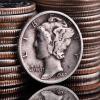
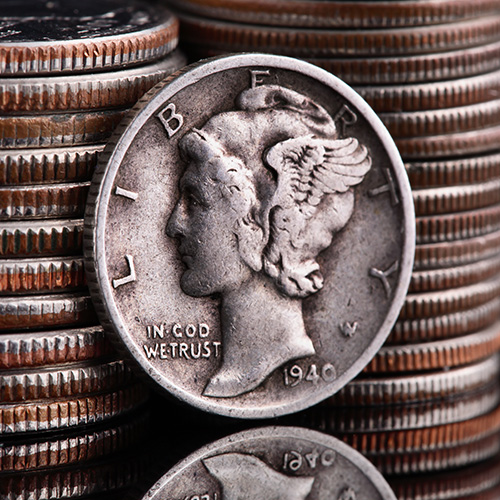
Adolph A. Weinman's Winged Liberty Head Dime, struck from 1916 to 1945, is the most collected dime series ever made. The public called it the Mercury Dime because Liberty's winged cap looked like the Roman messenger god, and the name stuck. Liberty's cap actually symbolizes freedom of thought; the reverse fasces and olive branch stand for strength through unity and peace.
Three dates anchor the series.
1916-D. The Denver Mint struck only 264,000 in the design's first year before the dies were needed for quarters. Roughly 10,000 are thought to survive. It is the key to the series by a wide margin, and it brings four figures even in worn grades. Counterfeits and added mint marks are common, so a 1916-D belongs in a PCGS holder.
1921 and 1921-D. Struck during the post-war recession, when the Mint had little demand for new dimes, both dates came in barely over a million pieces. Both are scarce in every grade and rare in Mint State.
Two more belong on any list. The 1942/1 and 1942/1-D overdates show a 1 beneath the 2 in the date, the result of a hub from the prior year being used on a 1942 die. And the 1931-S closes the first chapter: the last dime struck before production paused for two years during the Depression.
What Full Bands means
Flip a Mercury Dime over. The fasces at center is bound by three sets of horizontal bands. On most coins, the two central bands are mushy and run together, because that is the highest point of the design and the first place the strike falls short. When those two central bands are fully struck and completely separated, PCGS designates the coin Full Bands, abbreviated FB on the label.
Full Bands is a strike designation, not a grade. An MS65 and an MS65 FB are the same grade of coin; the FB example was struck sharper. For some dates the designation is common and adds little. For others, the 1945 Philadelphia issue most famously, a Full Bands strike is scarce enough that collectors pay many times the price of an ordinary MS65. Learning to see the difference takes a loupe and about five minutes with two coins side by side.
Modern rarities
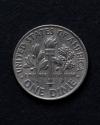
The Roosevelt Dime, struck since 1946, is the dime in your pocket, and most dates are worth exactly ten cents. Two exceptions come from the San Francisco Mint's proof presses.
1968 No S Proof. The first proof coin ever accidentally struck without its S mint mark. The error was caught quickly, and only a few dozen are known. With mirror fields and frosted devices, it is a proof in every respect except the missing letter.
1975 No S Proof. Rarer still. Only two examples are known, which makes it one of the most valuable modern American coins of any denomination, and a coin that sells for six figures when one comes to market.
These are the dimes that prove rarity is not about age. Both were struck within living memory, and both exist because someone at the Mint missed a step.
How grading changes value
Grade is the single largest factor in what a dime brings, and dimes show wear fast. On a Mercury Dime, wear appears first on Liberty's cheek and hair and on those central bands. On a Barber Dime, look at Liberty's cheek and the high points of the wreath.
Three worked examples from our inventory show the range:
-
G4 (Good). The design is complete in outline and the date is readable, but detail is worn flat. This is the set-filler grade, and for common dates it is the most affordable way into either series. [INVENTORY: G4 Mercury or Barber Dime, link and price]
-
VF20 (Very Fine). Moderate wear with most detail intact: hair strands visible on Liberty, bands defined on the reverse. The grade most album collectors build toward for a full date run. [INVENTORY: VF20 Mercury Dime, PCGS-certified, link and price]
-
MS65 (Gem Mint State). No wear, full luster, and only minor marks. This is where certification matters most: the difference between MS64 and MS65 is invisible to most eyes and worth a meaningful premium, and the PCGS label is what settles it. [INVENTORY: MS65 Mercury or Barber Dime, PCGS-certified, link and price]
We grade every raw coin in-house to ANA standards and sell PCGS-certified coins across all three of these tiers.
Where to start
Both classic series reward collectors at every level. A circulated Barber set filler costs less than lunch. A Full Bands gem is a registry coin. In between sits the date run most collectors actually build, one honest VF or XF at a time.
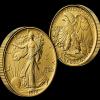
If the design is what draws you, the Mint's Best of the Mint Mercury Dime Gold Coin and Silver Medal Set gives Weinman's Winged Liberty its first strike in gold, and we have PCGS-certified sets in stock. The same design returns this fall on the 2026 Palladium Eagle; our companion article traces Winged Liberty from the 1916 dime to the palladium strike.
Every certified coin ships with its PCGS grade guaranteed. Standard orders ship free by USPS Ground Advantage, every order carries a 15-day return privilege, and layaway is available on in-stock coins over $100: 20% down, four monthly payments, five total, zero interest. Browse Mercury Dimes and Barber Dimes, or call 1-800-669-0953. We have been grading dimes as a family since 1974.
About the Author