Kennedy Half Dollar Values: Silver Years, Key Dates, and What Your Coin Is Worth

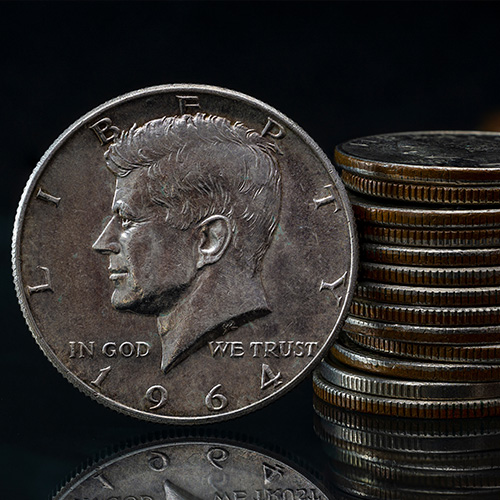
Most coin series earn their place in collections through rarity or age. The Kennedy Half Dollar earned its place through something stranger: a nation that received a new coin and refused to let it go. Sixty years on, that refusal shapes the whole series, from the silver originals of 1964 to the San Francisco proofs collectors chase today. Here is the series in full, with the dates, varieties, and grading guidance that answer the question collectors ask most: what is a Kennedy Half Dollar worth?
The Half Dollar America Kept
The Kennedy Half Dollar moved from idea to circulating coin faster than nearly any design in Mint history. Within weeks of President Kennedy's death in November 1963, Congress authorized a new half dollar in his honor. Gilroy Roberts prepared the portrait for the obverse and Frank Gasparro adapted the presidential seal for the reverse, and the first coins reached banks in March 1964.
Then the unusual part happened. Americans lined up for the new half dollar and did not spend it. Struck in 90 percent silver in a year of national mourning, the coin was kept as a memento, gifted, and tucked away by the millions. The Mint struck enormous quantities trying to meet demand, and the coins kept disappearing into drawers and keepsake boxes. The half dollar, a workhorse denomination for over a century, never truly returned to circulation. That is why the series feels different from every other modern coin: it was collected from the day it appeared.
The Silver Years: 1964, Then 1965 to 1970
Silver content is the first question in any Kennedy value conversation, and the series splits cleanly into eras.
The 1964 issues, from Philadelphia and Denver, are the 90 percent silver originals, the only year the Kennedy Half Dollar carried the traditional silver composition. They remain the coins collectors reach for first, both for the composition and for the year itself.
From 1965 through 1970, the Mint reduced the coin to 40 percent silver as rising silver demand pushed the metal out of circulating coinage. These transitional years are the middle chapter: still silver, struck in a period when the Mint was redesigning American coinage around clad compositions, and often overlooked by collectors who stop at 1964. The 1970-D closes the era with a twist covered below.
From 1971 forward, circulation strikes moved to copper-nickel clad, with one celebrated interruption: the dual-dated 1776-1976 Bicentennial design, which replaced the presidential seal reverse with Seth Huntington's Independence Hall for the anniversary year. Silver returned in collector issues, and the San Francisco silver proofs carry the composition forward today.
Telling the eras apart takes seconds. Check the date first. For a quick second check on 1965 to 1970 coins, the edge of a 40 percent silver half shows a muted silver tone, where the clad coins from 1971 on show a visible copper stripe.
Key Dates and Varieties Worth a Second Look
The series has no impossible rarities, and that is part of its appeal: a complete date run is a realistic goal. A handful of issues stand above the rest.
The 1964 Accented Hair proof came from the earliest proof dies, showing heavier detail in the hair above Kennedy's ear. The story goes that the design was softened early in the proof run, making the Accented Hair version the scarcer first state and a recognized variety collectors single out.
The 1964-D doubled die obverse shows doubling on the obverse, most visibly in the IN GOD WE TRUST motto and the profile. Our guide to rare half dollars covers it in depth: circulated examples bring a few hundred dollars, and high-grade examples have brought well over $10,000.
The 1970-D was never released to circulation at all. It came only in the year's Mint sets, making it the lowest-mintage circulation-style coin of the silver era and the date most often missing from otherwise complete runs.
Honest guidance on the rest of the series: common dates in circulated condition are plentiful and inexpensive, which makes them ideal starter coins. The value conversation changes with silver content, with the varieties above, and most of all with grade.
How Grading Changes Value
Condition drives value across the series, and the spread between a circulated example and a gem is wide enough to reward knowing the difference. A few worked examples from current PCGS-certified inventory show the shape of the market:
-
A circulated 1964 silver original carries the year and the composition at the most approachable price in the series.
-
An MS63 example shows full mint luster with light contact marks, the collector-grade sweet spot for date runs.
-
An MS65 gem shows the design as Roberts and Gasparro intended it, with clean fields and strong strike.
Every certified coin carries its grade on the PCGS holder, so the condition question is settled by a third party before the coin reaches you.
The Modern Proofs: Where the Series Is Headed
The series' newest chapter comes from San Francisco. The annual S silver proofs give the design its finest rendering, frosted devices over mirror fields in .999 fine silver, and they have become the issue collectors watch for each year. Last fall's silver proof was one of our fastest sellers of the season, and the 2026-S silver proof will follow when it arrives.
Sixty Years, One Series, Many Starting Points
The Kennedy Half Dollar rewards collectors at every level. A 1964 original for the story. The 40 percent years for the overlooked middle chapter. The 1970-D and the varieties for the hunt. The modern proofs for the design at its sharpest. Few series offer this many natural starting points at this many price levels.
Browse our Kennedy Half Dollar inventory, which covers the full run with PCGS-certified examples across grades. Standard orders ship free, every purchase carries our 15-day return privilege, and every certified coin ships with its PCGS grade guaranteed. Questions? Call us at 1-800-669-0953. We have been helping collectors build their sets since 1974.
About the Author