Indian Head Penny Value: Key Dates, Grades, and the End of the Cent

For the first time since 1793, the United States is not making cents for circulation. The cent is now a collector's coin, and that makes it a good moment to look at the series where generations of collectors started: the Indian Head Cent. This guide covers how the cent reached its final strike, how the Indian Head Cent changed across its fifty-one years, which dates are scarce, and how grade and color decide what a given coin brings.
The cent after 232 years
On November 12, 2025, the Philadelphia Mint struck its final cent for circulation, with US Treasurer Brandon Beach striking the ceremonial last coin. Production ended for a plain reason: each cent had come to cost 3.69 cents to make. About 300 billion cents remain legal tender, so the coin is not leaving pockets and cash registers any time soon. It has simply stopped being replaced.
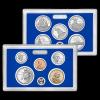
The Mint has said it will keep making cents for collectors in limited quantities, and 2026 is the first year that applies. No 2026 cents were struck for circulation. Every 2026 Lincoln Cent carries the 1776~2026 dual date of the anniversary year, and every one comes from a collector product. The P and D cents exist only in the 2026 Uncirculated Coin Set, released June 30. The S proof cents come in the 2026 Semiquincentennial Silver Proof Set, released June 11, and in the 2026 Proof Set, released October 6. If you want the first cent in American history made only for collectors, those sets are the only place to find it.
The 2026 cent closes a story that runs back more than two centuries. The most collected chapter of that story starts in 1859.
The Indian Head Cent, 1859-1909
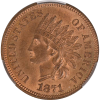
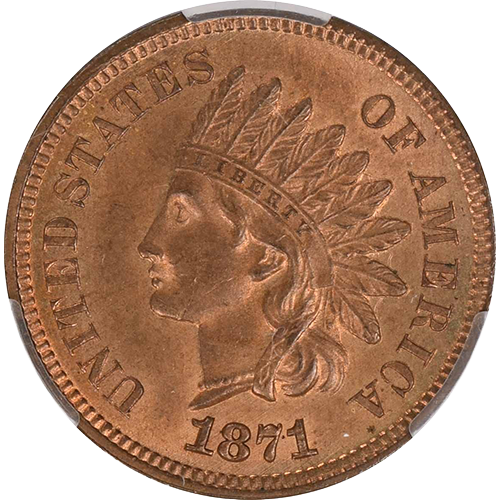
James B. Longacre, Chief Engraver of the Mint, designed the Indian Head Cent to replace the short-lived Flying Eagle Cent. His obverse shows Liberty wearing a feathered headdress, with UNITED STATES OF AMERICA around the rim and the date below. The coin ran from 1859 to 1909, through the Civil War and into the new century.
The series falls into two eras, and telling them apart is the first thing a new collector learns.
-
Copper-nickel, 1859 to 1864. The early coins are thick and pale, with a light tan or grayish color from the nickel content. They feel heavier in the hand than the later issues.
-
Bronze, 1864 to 1909. In 1864 the Mint changed to a thinner bronze planchet. These coins have the familiar copper color, and they are the ones that show Red, Red-Brown, and Brown color in Mint State.
Because the change happened partway through 1864, that year comes in both compositions. The bronze 1864 has a variety of its own: the L on the ribbon. Late in the year, Longacre's initial, a small L, was added to the ribbon at the back of Liberty's headdress, just behind her neck. Under a loupe, the 1864 L shows a clear letter on the ribbon end; the earlier bronze 1864 shows a plain ribbon. The L stayed on the design for the rest of the series, so it only matters as a variety in 1864. Find the lowest ribbon and check the tip for the letter.
Key dates and what makes them scarce
Most Indian Head Cents are plentiful, which is why the series makes such a good album project. Five dates set the pace for a complete set.
-
1877. The key to the series and the date every collector knows. It is also the most counterfeited date in the series, with altered dates and outright fakes turning up regularly, so an 1877 should be bought certified.
-
1909-S. The final year, struck at San Francisco in the last months before the Lincoln Cent took over. Scarce in every grade and in strong demand from collectors of both series.
-
1869. An early bronze key, scarce in all grades.
-
1872. Another early bronze key, tough to find with clear headdress detail.
-
1864 L. The variety above. More available than the others, but it carries a real premium over the plain-ribbon 1864, and attractive Mint State examples are hard to find.
Honest guidance on grades: most collectors fill these dates in circulated condition, and that is the right call. A Good 1877 with a clear date and full rims is a complete coin and a proud addition to an album. Mint State examples of the keys belong to a different collection and a different budget. Whatever the grade, the keys belong in PCGS holders, because these are the dates that attract altered and counterfeit coins.
How grading and color change value
Two things decide what an Indian Head Cent brings: how much wear it shows, and for Mint State bronze coins, how much of its original color survives. Wear shows first on the hair above Liberty's ear, the feather tips, and the word LIBERTY on the headband, and on the reverse at the wreath.
Four grades cover most of what changes hands.
-
Good (G4). Heavy wear. Liberty is an outline, the headband is worn smooth, and the date and legends are clear. The set-filler grade for the keys and the most affordable way to own an 1877.
-
Very Fine (VF20). Moderate wear. The full word LIBERTY reads on the headband, a key marker for this grade, and the feathers show separation. A favorite target for album collectors.
-
MS63 (Choice Mint State). No wear, full luster, scattered marks or spots that keep it from gem. The everyday Mint State grade for type collectors.
-
MS65 (Gem). Full luster, a sharp strike, and only minor marks. At this level color becomes as important as the number.
Color is where bronze cents differ from every other American series. Copper tones over time, from bright orange red to a deep chocolate brown, and PCGS records the result on the label next to the grade.
-
Red (RD). The coin keeps its original mint color, or nearly all of it. The scarcest and most sought-after designation.
-
Red-Brown (RB). A mix of original red and toned brown. The most common designation for older Mint State bronze cents.
-
Brown (BN). The coin has toned fully brown. Still Mint State, still fully detailed, and the most affordable way into the higher grades.
Two coins at MS65 can bring very different amounts depending on whether the label reads RD or BN. Registry collectors chase Red; many type collectors prefer an original Red-Brown with even color. Neither is the wrong choice. What matters is that the color is original, and the PCGS designation settles that question on the label.
From Indian Head to Lincoln
In 1909, the centennial of Abraham Lincoln's birth, the Mint replaced the Indian Head Cent with Victor David Brenner's Lincoln Cent, the first circulating American coin to show a real person. Brenner placed his initials, VDB, at the bottom of the reverse. The initials drew public objection and were removed within weeks, and the San Francisco coins struck before the change became the 1909-S VDB, the most famous key in the Lincoln series. The year 1909 holds two of the most collected cents in American history: the last Indian Head key and the first Lincoln key.
The Lincoln series ran for 117 years of circulating production, and it has its own chase coins: the 1914-D, the 1931-S, the 1943 steel cents struck during the wartime copper shortage, and the 1955 Doubled Die Obverse. Our article on the rarest pennies covers those dates in depth, and more than 107,000 readers have used it to check their own coins. Read it next if your interest runs to Lincoln Cents.
Start your set
The cent story now has a beginning and an end. The Indian Head Cent opens the most collected chapter, the Lincoln Cent carries it for more than a century, and the 2026 dual-dated cents close it. A collector can hold all three in one album.
Browse the Indian Head Cents category for key dates, set fillers, and PCGS-certified Red and Red-Brown examples. Every certified coin ships with its PCGS grade guaranteed. Standard orders ship free by USPS Ground Advantage, every order carries a 15-day return privilege, and our team is a phone call away at 1-800-669-0953. We have been helping collectors build cent sets as a family since 1974.
About the Author