Morgan Dollar Guide: Key Dates, Mint Marks, and How Grading Works

More Americans collect Morgan Dollars than any other coin, and the reasons are not complicated. They are big, they are heavy, they are 90 percent silver, and they come from the part of American history everybody already has pictures of in their head: mining towns, cattle drives, saloons that took a dollar coin because paper money was not trusted west of the Missouri.
They are also collectible at almost any level. Common dates in circulated grades are among the most accessible classic silver coins in the market. The key dates are among the most difficult. A single series covers that whole distance, which is why collectors stay with it for decades.
Here is how the series works.
The Basics
George T. Morgan designed the coin, and he got the job by winning an in-house competition at the Philadelphia Mint against the Barbers, the father and son who ran engraving there. Morgan was a young engraver recruited from the Royal Mint in London. His Liberty was modeled on Anna Willess Williams, a Philadelphia schoolteacher, which made her the first American woman to sit for a circulating coin portrait.
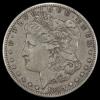
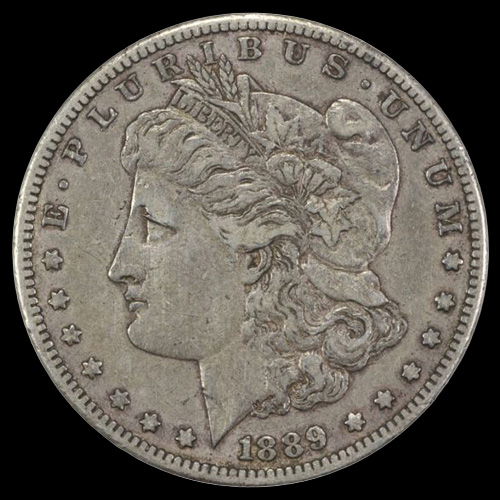
The obverse shows Liberty in profile facing left, wearing a Phrygian cap with wheat and cotton in her hair, a deliberate pairing of Northern and Southern agriculture on a coin struck thirteen years after the Civil War ended. The reverse carries an eagle with wings spread, clutching arrows and an olive branch.
Struck from 1878 to 1904, then again in 1921, then revived by the Mint in 2021. The coin measures 38.1mm across and contains just over three quarters of an ounce of pure silver.
Mint marks sit on the reverse, below the wreath, between the D and the O in DOLLAR. No mint mark means Philadelphia.
The Five Mints
Morgan Dollars were struck at more mints than almost any other American series, and the mint mark does as much work as the date.
Philadelphia (no mint mark). The largest mintages and the most common dates.
New Orleans (O). Heavy production, and O mint Morgans have a reputation for softer strikes. A flat spot over Liberty's ear on an O mint coin is often a strike characteristic rather than wear, which is a distinction that catches new collectors out.
San Francisco (S). Generally well struck, with sharp detail. The 1893-S is the key date of the entire series.
Carson City (CC). The one collectors chase. Carson City struck Morgans only in scattered years and always in small numbers, and the mint closed for good in 1893. Every CC Morgan is scarce relative to its Philadelphia counterpart, and the CC mint mark carries a premium across the board.
Denver (D). One year only, 1921, the final year of the original series.
Key Dates
1893-S. The king. Roughly 100,000 struck, the lowest circulation mintage in the series, and difficult in any grade. Mint State examples are legitimately rare.
1889-CC. The key Carson City date and the one CC collectors build toward.
1895. The Philadelphia issue of 1895 is known to collectors as the King of the Morgans because business strikes are essentially unobtainable. What exists in the market are proofs. A date set of Morgans is generally considered complete without it, which tells you something.
1893-O, 1894, 1895-O, 1896-O, 1901. The second tier. Each is difficult in Mint State even where circulated examples turn up.
The CC run generally. 1879-CC, 1885-CC, 1889-CC, and 1893-CC are the harder Carson City dates. The 1882-CC, 1883-CC, and 1884-CC are the accessible ones, largely because of the GSA hoard: in the 1970s the government sold off millions of uncirculated Carson City Morgans that had been sitting in Treasury vaults since they were struck, and those three dates made up the bulk of it.
How Grading Changes Everything
On Morgan Dollars, grade matters more than almost anything else, and the reason is the melting.
The Pittman Act of 1918 authorized the destruction of over 270 million silver dollars, and what came out of the vaults to be melted was largely uncirculated coins that had never left storage. Millions of Mint State Morgans disappeared. What survived in high grade survived by accident.
That history is why a common date Morgan in Very Fine and the same coin in MS65 sit in completely different places, and why the jump from MS64 to MS65 on this series is the most consequential single grade step in American numismatics.
What graders are looking at:
Cheek and field. Liberty's cheek is a large, open, high-relief surface, which means every contact mark from bag handling shows there. Marks on the cheek are the most common thing holding a Morgan back from a higher grade.
Luster. Morgans should show a rotating cartwheel effect across the fields when the coin is tilted under light. Broken or muted luster caps the grade.
Strike. Detail over the ear and in the eagle's breast feathers. A weak strike is not wear, and telling them apart is the skill that separates experienced graders from everybody else.
Surfaces. Cleaning is the frequent problem. A dipped or polished Morgan is identifiable and will be graded as damaged rather than at its apparent grade.
Circulated grades run from About Good through AU58. Mint State runs MS60 through MS70. The practical range for most collectors is MS63 through MS65, where the coins still look the way a Morgan should look without reaching into the grades where population counts get thin.
Where to Start
Common date BU. One nice uncirculated Morgan, an 1881-S or an 1885-O, both of which exist in quantity in high grade. This is the standard first Morgan and it should be.
Mint mark type set. One coin from each of the five mints. Five coins, and the whole geography of the series is on the shelf.
Date and mint set. The full run. A long project, and the four or five key dates are what make it a project rather than a purchase.
Carson City focus. CC Morgans only. A defined, finite goal with real difficulty at the top and a strong story behind every coin.
Morgan Dollars at L&C Coins
Morgan Dollars are our deepest category, with more than 9,300 coins in stock across every date, mint, and grade the series offers. Circulated examples for set builders, PCGS-certified Mint State coins for collectors working the higher grades, and CC Morgans as we acquire them.
Free shipping on standard orders, a 15-day return privilege, and layaway at 20 percent down with four interest-free monthly payments. Our family has been buying and selling Morgans since 1974. Call us at 1-800-669-0953 with any question about the series.
About the Author