Standing Liberty Quarter Guide: Key Dates, Full Head, and the 1916

Hermon A. MacNeil's Standing Liberty Quarter lasted fifteen years, from 1916 to 1930, and in that time it was redesigned once, interrupted by a world war, altered to fix a wear problem it never fully solved, and then replaced. It is one of the shortest-lived designs in American coinage and one of the most admired.
It also produced a first-year issue that ranks among the genuine rarities of twentieth century American coins, and a grading designation that collectors of no other series have to think about.
The Design
MacNeil was a sculptor, not a mint engraver, and he came to the quarter through the same push for better American coinage that brought Saint-Gaudens to the $20 Gold and Weinman to the dime and the half dollar.
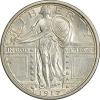
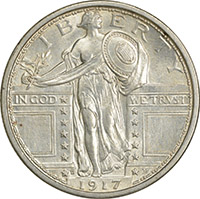
The obverse shows Liberty standing in an opening in a wall bearing 13 stars, a shield raised on her left arm and an olive branch extended in her right. Defense and peace held simultaneously, on a coin designed in 1916 while Europe was two years into a war the United States had not yet entered. The reverse carries an eagle in flight.
The design's problem was structural. The date sat on a raised, exposed area at the base of the obverse and wore away faster than anything else on the coin. Quarters that had circulated for a decade came back dateless, which is why so many surviving Standing Liberty Quarters from the early years cannot be attributed at all.
The Two Types
Type 1, 1916 to early 1917. The original design. Liberty's chest is uncovered and the eagle on the reverse sits lower with three stars beneath it.
Type 2, 1917 to 1930. Liberty wears a mail shirt over her chest, and the reverse eagle is repositioned higher with the stars rearranged, five below and two flanking. The traditional explanation for the mail shirt is public objection to the original figure. The likelier explanation, and the one most researchers now favor, is that the Mint was making design adjustments for striking and wear alongside the reverse changes, and the armor came with them. Both types were struck in 1917, which makes that year the one date where a collector needs two coins.
A further change came in 1925. The Mint recessed the date into the field rather than leaving it raised, which finally addressed the wear problem. Coins from 1925 through 1930 hold their dates. Coins from 1916 through 1924 frequently do not.
Key Dates
1916. Mintage of 52,000, struck in the last weeks of the year, and the key to the series by a wide margin. It is also the coin that makes a complete date set a serious undertaking. Genuine examples are scarce in every grade and the date is a counterfeiting target, so certification is not optional here.
1918/7-S. An overdate, created when a 1917 die was repunched with a 1918 date and the underlying 7 remained visible beneath the 8. One of the most sought overdates in American coinage and difficult in all grades.
1927-S. Mintage of 396,000 and the condition rarity of the series. Circulated examples exist; Mint State examples, particularly well struck ones, are genuinely hard.
1923-S and 1921. Both are low mintage dates that collectors have to plan for, and both are frequently found with worn or missing dates.
Any pre-1925 coin with a full, readable date carries interest beyond its grade, simply because so many do not have one.
Full Head, and Why It Matters Here
This is the designation that separates Standing Liberty Quarters from other series.
The Mint struck these quarters inconsistently. On many coins, particularly from the San Francisco and Denver mints, the detail in Liberty's head never came up fully from the dies even on coins that never circulated. A perfectly uncirculated quarter can have a head that looks flat.
Full Head, abbreviated FH, is the designation applied when three specific details are present and complete: the hairline along Liberty's brow, the ear opening, and the three leaves in her hair. PCGS applies it as a suffix to the grade, so a coin is certified MS65FH rather than MS65.
For collectors, the practical consequence is that MS65 and MS65FH are treated as two different coins on this series. On some dates the FH examples are dramatically scarcer than the numerical grade alone would suggest. Anyone building a high grade Standing Liberty set decides early whether they are chasing Full Head coins, because it changes the difficulty of the project substantially.
Grading the Series
The date first. On any coin before 1925, check whether the date is complete and readable. This precedes every other question.
The shield and the knee. Liberty's shield detail and the high point of her forward knee are the primary wear checkpoints.
Head detail, separately from wear. As above, a flat head can be a strike characteristic rather than circulation. Judge the fields and the luster to determine whether a coin is uncirculated, then judge the head separately.
Surfaces. These quarters are 90 percent silver and toning is common and often attractive. Cleaning is not, and it is identifiable.
Building a Set
Type set. One Type 1 and one Type 2. Two coins, and the design story is complete.
Short set, 1925 to 1930. The recessed date years. Every coin holds its date, the dates are obtainable, and it is the most practical way to collect the series completely at a reasonable level. This is where most collectors of this quarter start.
Full date and mint set. All years and mints including the 1916 and the 1918/7-S. A serious long-term project.
Full Head focus. Certified FH examples across the run. Difficult, defined, and the way advanced collectors approach the series.
The Gold Connection
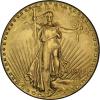
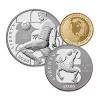
The Mint's Best of the Mint series included the 1916 Standing Liberty Quarter as its second release, striking MacNeil's design in 24-karat gold with a Liberty Bell 250 privy mark, paired with a silver medal showing a windswept Liberty offering olive branches to a distant eagle. For collectors who know the original series, the gold coin displays best next to the quarters it was drawn from.
Standing Liberty Quarters at L&C Coins
We carry the series across grades, from circulated examples in the recessed date years for set builders to PCGS-certified Mint State coins including Full Head designations. Our numismatists have been handling this series since the family opened the doors in 1974.
Shop Standing Liberty Quarters
Free shipping on standard orders and a 15-day return privilege. Call us at 1-800-669-0953 with questions about the series.
About the Author