Peace Dollar Guide: The 1921 High Relief, Key Dates, and Building the Set

The Peace Dollar exists because a war ended and somebody decided the country should put that on a coin.
The American Numismatic Association had been pushing since 1918 for a coin commemorating peace after the armistice. Congress never passed a bill authorizing one. What happened instead is that the Pittman Act required the Mint to strike replacement silver dollars for the millions that had been melted, the Mint needed a design, and the Treasury had the authority to change a coin design that had been in use for more than 25 years. The Morgan Dollar qualified. A competition was held in late 1921, Anthony de Francisci won it, and the first Peace Dollars were struck in the final days of December.
The whole thing came together in about six weeks. That deadline is why the first year of the series is the most interesting coin in it.
The Design
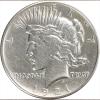
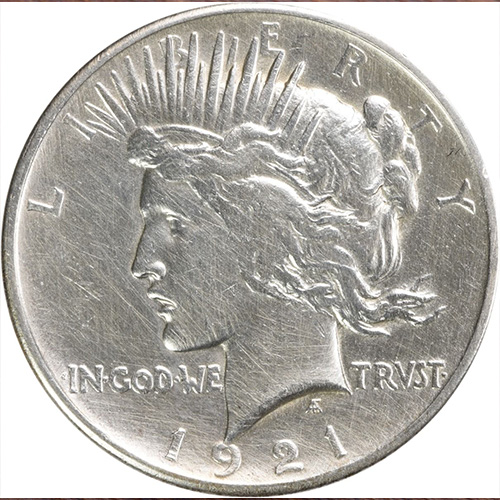
De Francisci modeled Liberty on his wife Teresa. The obverse shows her in profile facing left, wearing a radiate crown, the same visual language as the Statue of Liberty. The reverse carries an eagle at rest on a rock, an olive branch in its talons, looking toward a sunrise, with the word PEACE below.
The original reverse design had the eagle clutching a broken sword, meant to signal the end of fighting. Public reaction ran against it immediately, on the reading that a broken sword suggests defeat rather than peace. The Mint's Chief Engraver removed it before production, which is why the reverse you see has a rock where the sword used to be.
Struck from 1921 to 1928, then 1934 and 1935. Fourteen years and 24 date and mint combinations, which makes it the shortest and most approachable of the classic silver dollar series.
The 1921 High Relief
The 1921 Peace Dollar is a different coin from every Peace Dollar that followed, and collectors treat it as its own type.
De Francisci's original design was struck in high relief, meaning the devices stand up dramatically from the fields. It is a striking coin in hand and it looks nothing like the flatter issues from 1922 onward. It also did not work in production. High relief coins require enormous striking pressure, dies failed quickly, and the coins did not stack properly for banks. The Mint abandoned the relief after a little over a million pieces and moved to the low relief version used for the rest of the series.
Two practical notes for anyone looking at one. The high relief coins are almost always weakly struck at the center of Liberty's hair, so a soft spot there is normal rather than a defect. And because of the relief, the highest points wore quickly in circulation, which means high grade examples are harder than the mintage figure suggests.
A 1922 High Relief exists as well, from a brief attempt to continue the design in the second year, but those are proofs and patterns rather than circulating coins, and they are among the rarest American silver dollars.
Key Dates
The Peace Dollar has fewer difficult dates than the Morgan, which is part of what makes the set attractive.
1928. Mintage of 360,649, the lowest of the series, and the only Philadelphia issue that is genuinely scarce. The date every Peace Dollar collector has to plan for.
1921. The High Relief first year. Available, but conditionally scarce in higher grades for the reasons above.
1934-S. The condition rarity of the series. Circulated examples turn up; Mint State examples are difficult and get expensive quickly above MS64.
1927-D and 1928-S. The second tier. Both are challenging in Mint State with strong luster.
1924-S and 1925-S. San Francisco strikes from the mid-1920s are notorious for weak central detail, so finding a well struck example is harder than finding an uncirculated one.
Everything else in the run is obtainable, which is the appeal. A collector can realistically complete a Peace Dollar date and mint set.
Grading Notes Specific to the Series
Peace Dollars grade differently from Morgans and applying Morgan habits to them leads people wrong.
Strike is the recurring issue. Peace Dollars, particularly the S mint issues, were frequently struck softly at the center. Flat detail in Liberty's hair above the ear does not automatically mean wear. Look at the fields and the high points of the cheek instead; a coin with full luster and flat hair detail is an uncirculated coin that was poorly struck.
The hair over the ear and the eagle's feathers are the standard wear checkpoints once you have ruled out strike.
Luster carries the grade. Peace Dollars in original uncirculated condition show a distinctive satiny luster rather than the rotating cartwheel look of a Morgan.
Cleaning shows badly. The open fields on this design leave nowhere for hairlines to hide. A cleaned Peace Dollar is obvious to a grader.
Mint State grades run MS60 through MS70. Most collectors build in the MS63 to MS65 range, where the coins are attractive and populations are healthy.
Building a Peace Dollar Set
Type coin. One nice example, usually a common date from the mid 1920s in MS64 or MS65, plus a 1921 High Relief if you want both types represented.
Short set. The 1934 and 1935 issues, four coins, which closes out the series and includes the tougher 1934-S.
Full date and mint set. All 24 coins. This is the realistic complete classic silver dollar set, and 1928 is the date to plan around from the start.
Alongside the Morgans. Many collectors run the two series together, since they are the same denomination and the same silver content, separated by a single year and an entirely different idea about what a coin should say.
The 2026 Connection
The Mint revived both designs in 2021 and has continued them, and the 2026 issues carry the Semiquincentennial dual date and the Liberty Bell 250 privy mark. For collectors who have built the classic run, the modern strikes are a way to extend a set that closed in 1935. We carry the current Morgan and Peace releases alongside the originals.
Peace Dollars at L&C Coins
Our Peace Dollar inventory runs the full series, from circulated examples for set builders through PCGS-certified Mint State coins. The 1921 High Relief and the 1928 turn up as we acquire them, and both move quickly.
Free shipping on standard orders, a 15-day return privilege, and layaway on qualifying purchases. Call us at 1-800-669-0953 with any question about the series.
About the Author